 Bangkok condos squeezed by floods, weak demand and 65,300-unit glut
THIS NEWS ARTICLE KINDLY SPONSORED BY FALLPROTEC, A WORLD-RENOWNED NAME IN THE DESIGN AND MANUFACTURE OF PREMIUM FALL PROTECTION SYSTEMS AND HEIGHT ACCESS SOLUTIONS
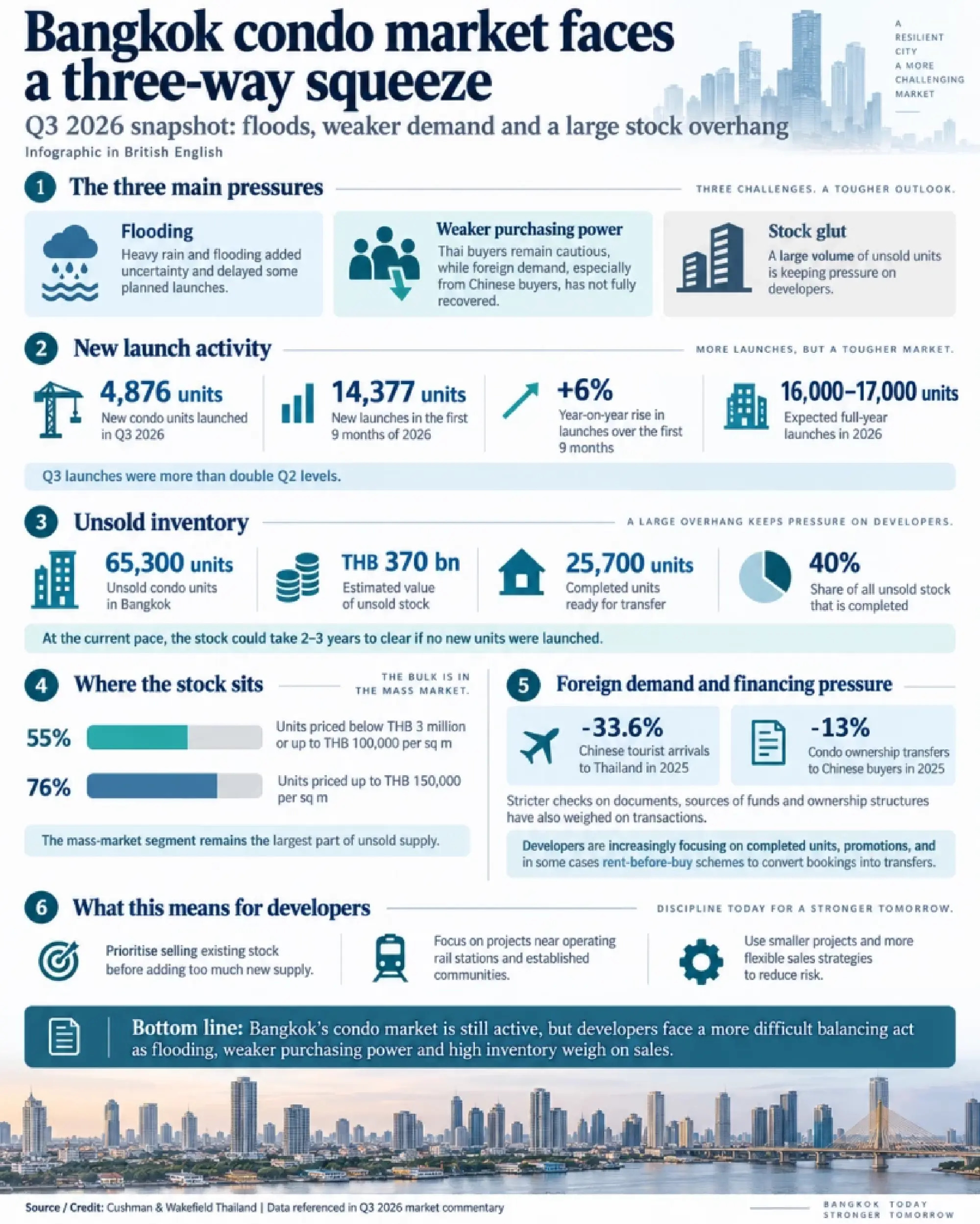
- The Bangkok condo market is facing an oversupply of more than 65,300 unsold units, valued at approximately THB370 billion, which could take 2-3 years to sell.
- Demand is weak due to diminished purchasing power from both domestic buyers, who face mortgage difficulties, and foreign buyers, particularly from China, whose interest has not recovered.
- Recent heavy rain and flooding have created additional uncertainty, prompting some developers to postpone new project launches while they assess market conditions and risks.
Bangkok’s condominium market is facing mounting pressure from weaker Thai and foreign purchasing power, flooding and a large stock of unsold units, despite a rise in new launches during the first nine months of 2026.
Surachet Kongcheep, Head of Research & Consulting at Cushman & Wakefield Thailand, said the market faced a more complicated challenge in the third quarter than simply competing on location and price.
Economic weakness has weighed on domestic purchasing power, while demand from foreign buyers, particularly Chinese customers, has yet to recover. Heavy rain and flooding have added another layer of uncertainty.
The pressure prompted some developers to postpone new project launches planned for late September while they assessed market conditions.
Some projects instead opted for soft launches, allowing selected customers to make early reservations before a formal launch in the fourth quarter to test demand.
Surachet said developers were becoming increasingly cautious, with decisions on new projects depending not only on land availability and business plans but also on purchasing power, environmental risks and the likelihood of converting interest into completed sales.
New launches reach 14,377 units in nine months
Bangkok recorded 4,876 newly launched condominium units in the third quarter, more than double the second-quarter level.
This brought total launches during the first nine months of 2026 to 14,377 units, up 6% from the same period last year.
Several more projects are scheduled for the fourth quarter, with full-year launches expected at around 16,000 to 17,000 units.
Surachet cautioned that rising launch numbers did not mean the market had returned to full strength.
The more important issue is whether developers can turn new supply into sales and completed ownership transfers at a time when buyers remain cautious about spending.
New launches are therefore only the beginning, he said. Developers need to generate revenue without allowing unsold inventory to build further.
Rail access remains key to condo demand
Bangkok’s expanding urban rail network remains an important factor in determining where condominium projects are developed.
Most developers continue to favour locations along lines already in operation, adjusting project formats and prices according to distance from stations and the central business district.
Outer Bangkok has played an important role in accommodating new projects because prices are more accessible and the potential customer base is wider than in the city centre.
However, weaker purchasing power is changing investment strategies.
Developers are focusing more heavily on selling completed units ready for transfer or projects scheduled for completion this year.
New launches continue, but developers are increasingly choosing smaller projects with fewer units or, in some cases, completing construction before putting units on the market.
Locations with established demand and existing transport links are also attracting more interest than areas dependent on rail projects that have yet to be completed.
Unsold stock worth THB370 billion
The biggest challenge is the volume of condominium inventory already on the market.
Bangkok has more than 65,300 unsold units worth about THB370 billion, according to the market data.
Of these, around 25,700 units have already been completed and are ready for ownership transfer, representing about 40% of all remaining stock.
At the current pace, the inventory could take two to three years to clear if no new projects were launched.
For developers, prolonged inventory creates financial costs, maintenance expenses and delays in recognising revenue.
Condos priced below THB3 million, or no more than THB100,000 per square metre, account for about 55% of remaining stock.
When units priced between THB100,001 and THB150,000 per square metre are included, the proportion rises to about 76%.
These price brackets have accumulated the most inventory partly because developers launched large numbers of projects in these segments over previous years.
“The challenge now is not simply to build new projects, but to turn existing stock into ownership transfers while balancing current asset sales with future investment,” Surachet said.
Mass market remains largest segment
Developers continue to focus on condominiums priced at no more than THB150,000 per square metre because the segment reaches a broader customer base than the luxury market.
Potential buyers include both Thais and foreigners.
However, mortgage access remains a major obstacle for some domestic buyers, particularly in lower-priced projects.
Surachet said one of the market’s biggest problems was the gap between reservations and completed ownership transfers.
A customer may decide to buy and pay a reservation fee, but the transaction cannot be completed if the buyer is unable to secure a sufficient mortgage.
Some developers of units priced below THB100,000 per square metre have responded by allowing customers to rent first and seek financing to buy later when they are financially ready.
Discounts and promotional campaigns are also being used to accelerate sales of completed units.
These measures are not available at every project, but they reflect the greater flexibility developers need in the current market to turn bookings into completed transfers.
Chinese demand remains subdued
Weak Chinese purchasing power has added to pressure on Bangkok’s property market over the past one to two years.
The report cited safety concerns affecting Thailand’s image as one factor behind weaker demand.
Chinese tourist arrivals to Thailand fell 33.6% in 2025, while condominium ownership transfers to Chinese buyers declined 13% in the same year.
Chinese purchases remained subdued during the first half of 2026.
At the same time, closer scrutiny of documents, sources of funds and corporate ownership structures involving foreign nationals has made some transactions more difficult.
The tighter checks have affected buyers who previously used income or funds generated through businesses in other countries to purchase Thai property.
The slowdown has affected both condominiums and higher-priced houses, leaving developers more dependent on domestic buyers at a time when household incomes and access to credit remain constrained.
Flooding could change housing priorities
Flooding has created further uncertainty for the market, with some developers postponing launches because of recent conditions.
However, Surachet said the situation could also prompt some buyers to consider condominiums as an alternative to low-rise housing because upper-floor units face less direct risk of flood damage.
That does not mean condominium residents are insulated from flooding.
Access roads, transport, utilities and common areas can all be disrupted even when individual units remain dry.
Projects close to operating rail stations and surrounded by established communities and everyday facilities could therefore become more attractive if they allow residents to maintain daily routines during unexpected disruptions.
For developers, the combination of flooding, weak purchasing power and a THB370-billion inventory means the immediate priority is increasingly shifting from expanding supply towards reducing existing stock and ensuring that sales can be converted into completed ownership transfers.
Source: https://www.nationthailand.com/business/property/40072232 (Krungthep Turakij)
Google Translation:
[We apologise if any of the translation is incorrect: google Translation occasionally gets it wrong]
ตลาดคอนโดมิเนียมกรุงเทพฯ เผชิญภาวะกดดันจากน้ำท่วม ความต้องการซื้อที่ซบเซา และภาวะล้นตลาดด้วยยูนิตค้างสต็อกกว่า 65,300 ยูนิต
บทความข่าวนี้ได้รับการสนับสนุนโดย FALLPROTEC แบรนด์ระดับโลกด้านการออกแบบและผลิตระบบป้องกันการตกจากที่สูงและโซลูชันสำหรับการเข้าถึงพื้นที่สูงระดับพรีเมียม
ตลาดคอนโดมิเนียมในกรุงเทพฯ กำลังเผชิญกับภาวะอุปทานล้นตลาด โดยมียูนิตที่ยังขายไม่ได้มากกว่า 65,300 ยูนิต คิดเป็นมูลค่ารวมประมาณ 3.7 แสนล้านบาท ซึ่งคาดว่าจะต้องใช้เวลาถึง 2-3 ปีในการระบายสินค้าเหล่านี้ให้หมด
ความต้องการซื้ออยู่ในระดับต่ำเนื่องจากกำลังซื้อที่ลดลง ทั้งจากผู้ซื้อในประเทศที่ประสบปัญหาในการขอสินเชื่อที่อยู่อาศัย และผู้ซื้อชาวต่างชาติ โดยเฉพาะชาวจีนที่ความสนใจยังไม่ฟื้นตัวกลับมา
สถานการณ์ฝนตกหนักและน้ำท่วมในช่วงที่ผ่านมาได้สร้างความไม่แน่นอนเพิ่มเติม ส่งผลให้ผู้พัฒนาโครงการบางรายตัดสินใจเลื่อนการเปิดตัวโครงการใหม่ เพื่อประเมินสถานการณ์ตลาดและความเสี่ยงต่างๆ
ตลาดคอนโดมิเนียมในกรุงเทพฯ กำลังเผชิญแรงกดดันที่เพิ่มขึ้นจากกำลังซื้อทั้งของคนไทยและชาวต่างชาติที่อ่อนตัวลง รวมถึงปัญหาน้ำท่วมและปริมาณยูนิตค้างสต็อกจำนวนมาก แม้ว่าจะมีการเปิดตัวโครงการใหม่เพิ่มขึ้นในช่วง 9 เดือนแรกของปี 2026 ก็ตาม
นายสุรเชษฐ กองชีพ หัวหน้าฝ่ายวิจัยและที่ปรึกษาของ Cushman & Wakefield Thailand กล่าวว่า ในไตรมาสที่ 3 ตลาดต้องเผชิญกับความท้าทายที่ซับซ้อนยิ่งขึ้น ซึ่งเป็นมากกว่าแค่เรื่องการแข่งขันด้านทำเลและราคา
ภาวะเศรษฐกิจที่ชะลอตัวส่งผลกระทบต่อกำลังซื้อภายในประเทศ ในขณะที่ความต้องการจากผู้ซื้อชาวต่างชาติ โดยเฉพาะลูกค้าชาวจีน ยังไม่มีสัญญาณฟื้นตัว นอกจากนี้ ฝนที่ตกหนักและน้ำท่วมยังเป็นปัจจัยที่เพิ่มความไม่แน่นอนให้กับสถานการณ์อีกด้วย
แรงกดดันดังกล่าวทำให้ผู้พัฒนาโครงการบางรายตัดสินใจเลื่อนการเปิดตัวโครงการใหม่ที่วางแผนไว้ในช่วงปลายเดือนกันยายนออกไป เพื่อรอดูสถานการณ์ตลาด
บางโครงการเลือกใช้วิธีเปิดตัวแบบ Soft Launch (เปิดตัวอย่างไม่เป็นทางการ) โดยเปิดให้ลูกค้ากลุ่มเป้าหมายสามารถจองสิทธิ์ล่วงหน้าได้ก่อนการเปิดตัวอย่างเป็นทางการในไตรมาสที่ 4 เพื่อทดสอบกระแสตอบรับและความต้องการของตลาด
นายสุรเชษฐระบุว่า ผู้พัฒนาโครงการมีความระมัดระวังมากขึ้น โดยการตัดสินใจเกี่ยวกับโครงการใหม่ไม่ได้ขึ้นอยู่กับความพร้อมของที่ดินและแผนธุรกิจเพียงอย่างเดียว แต่ยังต้องพิจารณาถึงกำลังซื้อ ความเสี่ยงด้านสิ่งแวดล้อม และความเป็นไปได้ที่จะเปลี่ยนความสนใจของลูกค้าให้กลายเป็นการซื้อขายจริงได้สำเร็จ
ยอดเปิดตัวโครงการใหม่แตะระดับ 14,377 ยูนิตในรอบ 9 เดือน
กรุงเทพฯ มียอดเปิดตัวคอนโดมิเนียมใหม่จำนวน 4,876 ยูนิตในไตรมาสที่ 3 ซึ่งถือเป็นตัวเลขที่สูงกว่ายอดเปิดตัวในไตรมาสที่ 2 ถึงกว่าเท่าตัว ส่งผลให้ยอดเปิดตัวโครงการใหม่ในช่วง 9 เดือนแรกของปี 2026 รวมอยู่ที่ 14,377 ยูนิต เพิ่มขึ้น 6% จากช่วงเดียวกันของปีก่อน
นอกจากนี้ ยังมีโครงการอีกหลายแห่งที่มีกำหนดเปิดตัวในไตรมาสที่ 4 โดยคาดการณ์ว่ายอดเปิดตัวรวมตลอดทั้งปีจะอยู่ที่ประมาณ 16,000 ถึง 17,000 ยูนิต
อย่างไรก็ตาม นายสุรเชษฐ์ตั้งข้อสังเกตว่า ตัวเลขการเปิดตัวโครงการที่เพิ่มขึ้นไม่ได้หมายความว่าตลาดได้กลับมาฟื้นตัวอย่างเต็มที่แล้ว
ประเด็นสำคัญกว่าคือ ผู้ประกอบการจะสามารถเปลี่ยนอุปทานใหม่ให้กลายเป็นยอดขายและการโอนกรรมสิทธิ์ได้หรือไม่ ในช่วงเวลาที่ผู้ซื้อยังคงระมัดระวังเรื่องการใช้จ่าย
เขากล่าวว่า การเปิดตัวโครงการใหม่เป็นเพียงจุดเริ่มต้นเท่านั้น ผู้ประกอบการจำเป็นต้องสร้างรายได้โดยไม่ปล่อยให้มีสินค้าคงเหลือสะสมเพิ่มขึ้น
การเข้าถึงระบบรางยังคงเป็นปัจจัยหลักต่อความต้องการคอนโดมิเนียม
เครือข่ายรถไฟฟ้าในเขตเมืองของกรุงเทพฯ ที่ขยายตัวอย่างต่อเนื่องยังคงเป็นปัจจัยสำคัญในการกำหนดทำเลที่ตั้งของโครงการคอนโดมิเนียม
ผู้ประกอบการส่วนใหญ่ยังคงให้ความสำคัญกับทำเลแนวรถไฟฟ้าที่เปิดให้บริการแล้ว โดยมีการปรับรูปแบบโครงการและระดับราคาให้สอดคล้องกับระยะห่างจากสถานีและย่านศูนย์กลางธุรกิจ (CBD)
พื้นที่รอบนอกกรุงเทพฯ มีบทบาทสำคัญในการรองรับโครงการใหม่ เนื่องจากระดับราคาที่จับต้องได้ง่ายกว่าและมีฐานลูกค้าที่กว้างกว่าเมื่อเทียบกับพื้นที่ใจกลางเมือง
อย่างไรก็ตาม กำลังซื้อที่อ่อนตัวลงกำลังส่งผลให้กลยุทธ์การลงทุนต้องปรับเปลี่ยนไป
ผู้ประกอบการหันมาให้ความสำคัญกับการขายยูนิตที่ก่อสร้างเสร็จพร้อมโอน หรือโครงการที่มีกำหนดแล้วเสร็จภายในปีนี้มากขึ้น
แม้จะยังมีการเปิดตัวโครงการใหม่อย่างต่อเนื่อง แต่ผู้ประกอบการมักเลือกพัฒนาโครงการขนาดเล็กที่มีจำนวนยูนิตน้อยลง หรือในบางกรณีก็เลือกที่จะก่อสร้างให้แล้วเสร็จก่อนนำออกสู่ตลาด
ทำเลที่มีความต้องการซื้อชัดเจนและมีการเชื่อมต่อด้านคมนาคมอยู่แล้ว ยังได้รับความสนใจมากกว่าพื้นที่ที่ต้องพึ่งพาโครงการรถไฟฟ้าที่ยังก่อสร้างไม่แล้วเสร็จ
สินค้าคงเหลือมูลค่า 3.7 แสนล้านบาท
ความท้าทายที่ใหญ่ที่สุดคือปริมาณสินค้าคงเหลือของคอนโดมิเนียมที่มีอยู่ในตลาด
ข้อมูลตลาดระบุว่า กรุงเทพฯ มีคอนโดมิเนียมที่ยังขายไม่ได้มากกว่า 65,300 ยูนิต คิดเป็นมูลค่ารวมประมาณ 3.7 แสนล้านบาท
ในจำนวนนี้ มีประมาณ 25,700 ยูนิตที่ก่อสร้างเสร็จแล้วและพร้อมโอนกรรมสิทธิ์ ซึ่งคิดเป็นสัดส่วนราว 40% ของสินค้าคงเหลือทั้งหมด
หากไม่มีการเปิดตัวโครงการใหม่เพิ่มเติม คาดว่าจะต้องใช้เวลาถึง 2-3 ปีในการระบายสินค้าคงเหลือเหล่านี้ให้หมดไปตามอัตราการขายในปัจจุบัน สำหรับผู้ประกอบการอสังหาริมทรัพย์ การมีสินค้าคงเหลือค้างอยู่ในตลาดเป็นเวลานานก่อให้เกิดต้นทุนทางการเงิน ค่าใช้จ่ายในการดูแลรักษา และความล่าช้าในการรับรู้รายได้
คอนโดมิเนียมที่มีราคาต่ำกว่า 3 ล้านบาท หรือมีราคาไม่เกิน 100,000 บาทต่อตารางเมตร คิดเป็นสัดส่วนประมาณร้อยละ 55 ของสินค้าคงเหลือทั้งหมด
หากรวมยูนิตที่มีราคาอยู่ระหว่าง 100,001 ถึง 150,000 บาทต่อตารางเมตรเข้าไปด้วย สัดส่วนดังกล่าวจะเพิ่มขึ้นเป็นประมาณร้อยละ 76
สินค้าคงเหลือในระดับราคาเหล่านี้มีจำนวนสะสมมากที่สุด ส่วนหนึ่งเป็นผลมาจากการที่ผู้ประกอบการเปิดตัวโครงการจำนวนมากในกลุ่มตลาดดังกล่าวในช่วงหลายปีที่ผ่านมา
“ความท้าทายในขณะนี้ไม่ใช่แค่การสร้างโครงการใหม่ แต่คือการเปลี่ยนยอดจองที่มีอยู่ให้กลายเป็นการโอนกรรมสิทธิ์จริง พร้อมทั้งสร้างสมดุลระหว่างการขายสินทรัพย์ที่มีอยู่กับการลงทุนในอนาคต” สุรเชษฐ์กล่าว
ตลาดระดับแมส (Mass Market) ยังคงเป็นกลุ่มใหญ่ที่สุด
ผู้ประกอบการยังคงมุ่งเน้นไปที่โครงการคอนโดมิเนียมที่มีราคาไม่เกิน 150,000 บาทต่อตารางเมตร เนื่องจากตลาดกลุ่มนี้เข้าถึงฐานลูกค้าได้กว้างกว่าตลาดระดับหรู
กลุ่มผู้ซื้อที่มีศักยภาพประกอบด้วยทั้งชาวไทยและชาวต่างชาติ
อย่างไรก็ตาม การเข้าถึงสินเชื่อที่อยู่อาศัยยังคงเป็นอุปสรรคสำคัญสำหรับผู้ซื้อในประเทศบางกลุ่ม โดยเฉพาะในโครงการที่มีระดับราคาต่ำกว่า
สุรเชษฐ์ระบุว่า ปัญหาใหญ่ประการหนึ่งของตลาดคือช่องว่างระหว่างยอดจองซื้อกับการโอนกรรมสิทธิ์ที่เสร็จสมบูรณ์
ลูกค้าอาจตัดสินใจซื้อและชำระเงินจองแล้ว แต่ธุรกรรมไม่สามารถเสร็จสิ้นได้หากผู้ซื้อไม่สามารถขอสินเชื่อได้ในวงเงินที่เพียงพอ
ผู้ประกอบการบางรายที่พัฒนาโครงการราคาต่ำกว่า 100,000 บาทต่อตารางเมตร ได้ปรับกลยุทธ์โดยอนุญาตให้ลูกค้าเช่าอยู่อาศัยก่อน แล้วค่อยหาแหล่งเงินทุนเพื่อซื้อในภายหลังเมื่อมีความพร้อมทางการเงิน
นอกจากนี้ ยังมีการใช้ส่วนลดและแคมเปญส่งเสริมการขายเพื่อเร่งระบายสต็อกห้องชุดที่ก่อสร้างเสร็จแล้ว
แม้มาตรการเหล่านี้จะไม่ได้มีใช้ในทุกโครงการ แต่ก็สะท้อนให้เห็นถึงความยืดหยุ่นที่ผู้ประกอบการจำเป็นต้องมีในสภาวะตลาดปัจจุบัน เพื่อเปลี่ยนยอดจองให้เป็นการโอนกรรมสิทธิ์จริง
ความต้องการจากผู้ซื้อชาวจีนยังคงซบเซา
กำลังซื้อที่อ่อนแอของชาวจีนเป็นปัจจัยที่เพิ่มแรงกดดันต่อตลาดอสังหาริมทรัพย์ในกรุงเทพฯ ตลอดช่วง 1-2 ปีที่ผ่านมา
รายงานระบุว่าความกังวลด้านความปลอดภัยซึ่งส่งผลกระทบต่อภาพลักษณ์ของประเทศไทย เป็นปัจจัยหนึ่งที่ทำให้ความต้องการซื้อลดลง
จำนวนนักท่องเที่ยวจีนที่เดินทางมายังประเทศไทยลดลง 33.6% ในปี 2025 ในขณะที่ยอดการโอนกรรมสิทธิ์คอนโดมิเนียมให้แก่ผู้ซื้อชาวจีนก็ลดลง 13% ในปีเดียวกัน
ยอดการซื้อของชาวจีนยังคงอยู่ในระดับต่ำในช่วงครึ่งแรกของปี 2026
ในขณะเดียวกัน การตรวจสอบเอกสาร ที่มาของเงินทุน และโครงสร้างความเป็นเจ้าของของบริษัทที่มีชาวต่างชาติเกี่ยวข้องอย่างเข้มงวดขึ้น ทำให้การทำธุรกรรมบางรายการมีความยากลำบากมากขึ้น
มาตรการตรวจสอบที่เข้มงวดขึ้นนี้ส่งผลกระทบต่อผู้ซื้อที่เคยใช้รายได้หรือเงินทุนจากธุรกิจในต่างประเทศเพื่อซื้ออสังหาริมทรัพย์ในไทย
ภาวะชะลอตัวดังกล่าวส่งผลกระทบต่อทั้งตลาดคอนโดมิเนียมและบ้านระดับราคาสูง ทำให้ผู้ประกอบการต้องพึ่งพาผู้ซื้อในประเทศมากขึ้น ในช่วงเวลาที่รายได้ครัวเรือนและการเข้าถึงสินเชื่อยังคงมีข้อจำกัด น้ำท่วมอาจเปลี่ยนลำดับความสำคัญด้านที่อยู่อาศัย
น้ำท่วมได้สร้างความไม่แน่นอนเพิ่มเติมให้กับตลาด โดยผู้พัฒนาอสังหาริมทรัพย์บางรายได้เลื่อนการเปิดตัวโครงการออกไปเนื่องจากสถานการณ์ล่าสุด
อย่างไรก็ตาม สุรเชษฐ์กล่าวว่า สถานการณ์นี้อาจกระตุ้นให้ผู้ซื้อบางรายพิจารณาคอนโดมิเนียมเป็นทางเลือกแทนบ้านเดี่ยว เนื่องจากห้องชุดที่อยู่ชั้นบนมีความเสี่ยงต่อความเสียหายจากน้ำท่วมโดยตรงน้อยกว่า
นั่นไม่ได้หมายความว่าผู้อยู่อาศัยในคอนโดมิเนียมจะปลอดภัยจากน้ำท่วม
ถนนทางเข้าออก การขนส่ง สาธารณูปโภค และพื้นที่ส่วนกลางอาจหยุดชะงักได้ แม้ว่าห้องชุดแต่ละห้องจะยังคงแห้งอยู่ก็ตาม
ดังนั้น โครงการที่อยู่ใกล้สถานีรถไฟที่ยังเปิดให้บริการ และล้อมรอบด้วยชุมชนที่มีสิ่งอำนวยความสะดวกในชีวิตประจำวัน อาจมีความน่าสนใจมากขึ้น หากโครงการเหล่านั้นช่วยให้ผู้อยู่อาศัยสามารถดำเนินชีวิตประจำวันได้ตามปกติในช่วงที่เกิดเหตุการณ์ไม่คาดฝัน
สำหรับผู้พัฒนาอสังหาริมทรัพย์ การรวมกันของน้ำท่วม กำลังซื้อที่อ่อนแอ และสินค้าคงคลังมูลค่า 370 พันล้านบาท หมายความว่าลำดับความสำคัญเร่งด่วนกำลังเปลี่ยนจากการขยายอุปทานไปสู่การลดสินค้าคงคลังที่มีอยู่ และทำให้มั่นใจว่ายอดขายจะสามารถเปลี่ยนเป็นการโอนกรรมสิทธิ์ได้อย่างสมบูรณ์