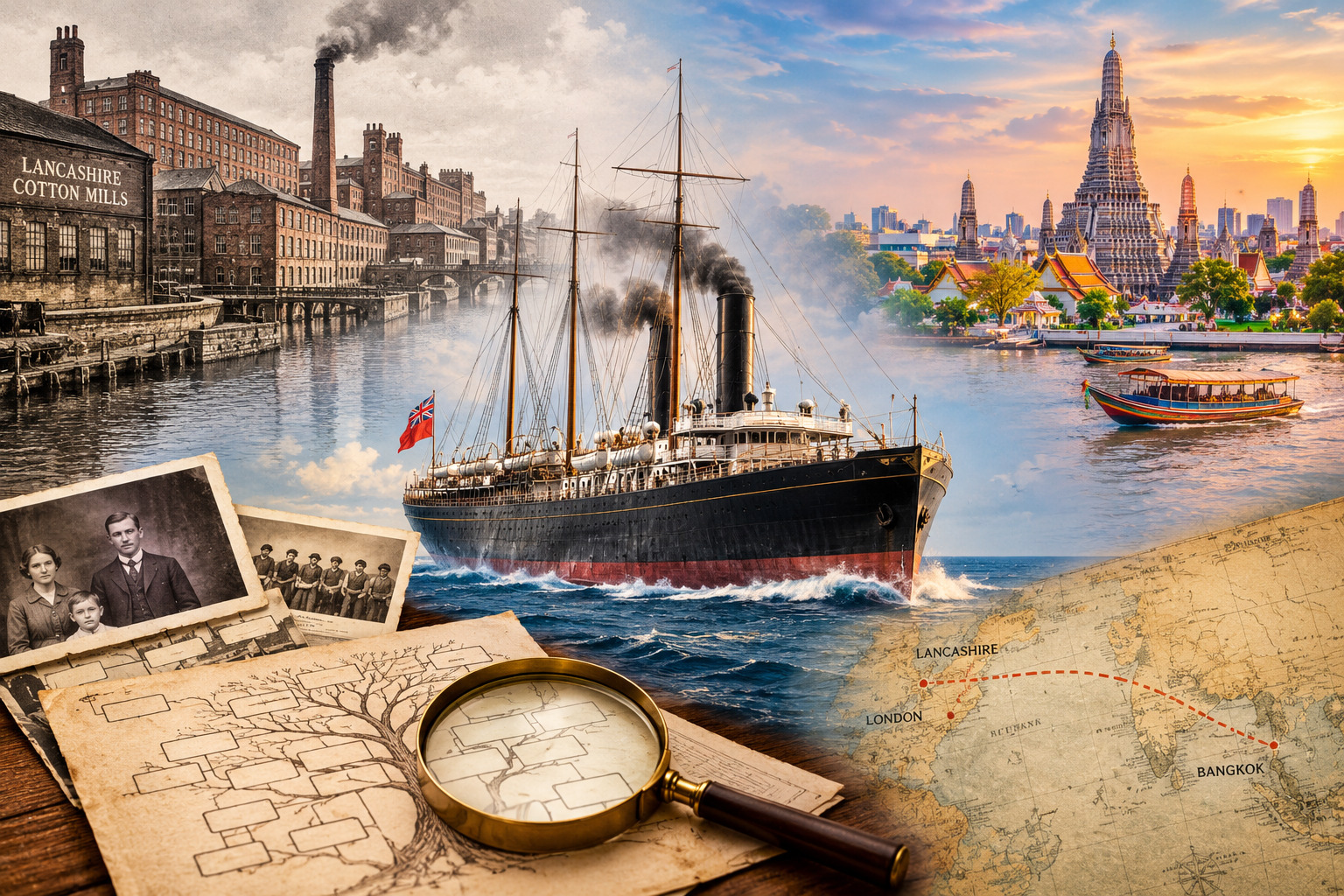
 From the 2026 Bangkok Floods to Ireland: Tracing My Family Tree
Eight generations, 105 people, and a discovery I never expected to make
When torrential rain brought flooding to Bangkok and the surrounding provinces in late September 2026, I found myself unexpectedly confined to home for five days. Rather than let those days pass unproductively, I finally tackled a project I had put off for years: tracing my family tree.
From Thursday afternoon to Saturday morning, 24–26 September 2026, Bangkok and the surrounding provinces experienced unusual non-stop torrential rain. Wikipedia’s ‘2026 Bangkok floods’ page describes it as follows:
“On 26 September 2026 at 10:16 local time (UTC+7), a flood disaster emergency was declared in Bangkok following 48 hours of continuous heavy rain, which submerged main roads and triggered mass evacuations. Over 300 mm (12 in) of rain was recorded in certain parts of Bangkok, with floodwaters blocking traffic on main roads in 37 locations. The Bangkok Metropolitan Administration (BMA) reported that it would take two to three days to drain the floodwaters after the rain stopped. Authorities declared all 50 districts of the city a disaster zone. It was the worst flooding to affect Bangkok in 15 years.”
On the Friday, such was the torrential rain we stayed at home all day. On the Saturday morning the rain let up and hearing that shops were running short of provisions as people wanted to take care of themselves in case the flooding lingered on, as often happens in Bangkok, we knew we had to make a run to the shops. Our SUV car was just about able to get through the flood waters, although, like many, we lost our front number plate due to a wave from a vehicle coming the opposite way, but fortunately two days later when the flood water reduced the number plate was found in our housing estate and returned to us.
In our housing estate we were very fortunate not to suffer greatly from the floods as we have our own pumps, but I have to say I have never seen the khlongs (canals) next to my housing estate burst their banks in the twenty-plus years I have lived in my house.
The local area was less fortunate.
The ancient Khlong Samrong, at over 55 km long, 50 m wide at its widest point and more than 5 m deep, runs from Bangkok to Bangpakong through my local area, is the main watercourse of Samut Prakan Province, and it burst its banks and flooded everything either side of it. Bang-Trat road was also flooded. It is extremely difficult to go anywhere of note in my local area without going near Khlong Samrong or Bang-Trat road.
We were therefore stuck at home because of the constant rain, and flooding resulting in very slow-moving traffic or impassable areas for five days before it began to be possible for us to go anywhere.
So, how did I spend those days at home?
I started tracing my family tree — something I had wanted to do for years but had never quite gotten around to doing.
My parents are both in their mid-90’s. Years ago when they last visited us in Thailand, my father passed me a scrappy piece of paper on which he had written some family names, and he was hinting that maybe it would be useful if I ever wanted to trace our family tree. Hint! Hint! Hint! At that time I was too busy working and taking care of my young family to trace family trees, so I put it away for safe keeping (so safe in fact that I can’t find it).
AI Can Trace Your Family Tree — But Can It Really?
A few days before the Bangkok flood commenced, I saw a TikTok video explaining that AI could trace your family tree for you. Interesting, but I did not do anything about it.
Then the three days of torrential rains came. I soon realized I needed something to do, and remembered the TikTok. I went back through old emails I had received from my father and noted down anything of interest about our family members, such as where he had told me they lived in the 1930s to 1960s, what they had worked as and where, anything like that, and I typed it up and fed it into ChatGPT with the request that:
“I want your help to build my family tree, so ask me everything you need to know to build my family
tree for me.
Based on my surname and where my family came from, tell me the origins of my family line and how far back you can trace it.
Using everything you know about me, go search public records, ancestry databases and obituaries to find relatives connected to my family.
Here are my details…”
The exchange with CHATGPT based on its prompts went back and forward between us but in truth ChatGPT found nothing new for me. What it did do though was suggest websites of BMD records (birth, deaths, marriage, etc) that I went to and searched (I seemed to be doing all of the research work, go figure!). It asked me questions and made prompts but found nothing. It recommended some of the paid-for websites. It suggested that I must be from Carlisle based on my surname – probably I am somewhere way back – but it offered me nothing useful really.
I knew that my grandfather, was born sometime between 1900 and 1915 in Salford, Lancashire, that he lived a great part of his life in the suburbs of Beswick and Bradford (where Manchester City’s Etihad Stadium is located), which is where my Father spent his early years. So my roots were in Salford, before my family moved the very short trip to Manchester.
My later research was to offer me a few shocks along the way.
How to Start Tracing Your Family Tree
I really did not want to incur any expense on this research so I avoided the paid-for websites and instead used some of the local BMD (Birth, Marriage, Death) websites suggested by CHATGPT, such as
- Lancashire BMD and Cheshire Lancashire BMD, and
- https://www.freebmd2.org.uk/
For some of my relatives I was able to find some or all of their birth, marriage and death records, but for others nothing was found.
I was later to find out that certain family surnames relevant to my family tree changed their spelling from their modern-day spelling to a slightly different spelling in the 1800s and the early 1900s, and for some of the very key members on the family tree I could not find sufficient details to enable me to backtrack further.
I took my research as back far as I could using the free websites, typed up all I had found out in a decent order in a file, and put it back into ChatGPT with the request:
“I want you to reformat the attached file in a nice and orderly format, that I can download or copy. There is no need for you to query any of the details in the file at this stage – just accept all as being correct.”
I was happy with what I had so far, but still not really satisfied, but I decided that was as far as I was going to take it. I shared the file with my siblings and hoped that someone in the family might be interested to pick it up at a date in the future and continue the search.
The Search Goes On
Watching TikTok again, I came across a lady who lives in the village next to my village just outside Manchester, who had just researched, written and published her own book ‘The Residents of Romiley Road: A History of a Cheshire Street in 1871’, and she had used paid-for websites to research the various families using England’s Census records.
England has held censuses every ten years since 1801 (except 1941), with full named census records surviving for 1841–1921.
She was explaining in the TikTok video that she has used two paid-for websites, one I will not name that she did not seem to like, and Ancestry.com (‘Ancestry’) which she praised profusely.
I decided I would check out Ancestry and maybe continue the research.
Researching 1800s Records with Ancestry
At the beginning of October 2026 I signed up for a subscription account with Ancestry.com. The choices are (i) UK Records Only, (ii) All UK & Ireland Records and (iii) All Records on Ancestry. As I was not aware of any relatives who might have travelled beyond the British Isles (which includes Ireland, Great Britain, the Isle of Man, Shetland, Orkney, and thousands of smaller islands), I chose the All UK & Ireland Records option.
Ancestry has some great records which you can search in yourself. It also has the ability to link you to other family trees to see if any of their relatives match your relatives.
For a period of a few nights, I got quite hooked searching for my relatives, finding out the addresses they lived, what they worked as, and so on.
It is not a particularly difficult website layout to use and I found my way around how to use it effectively very quickly.
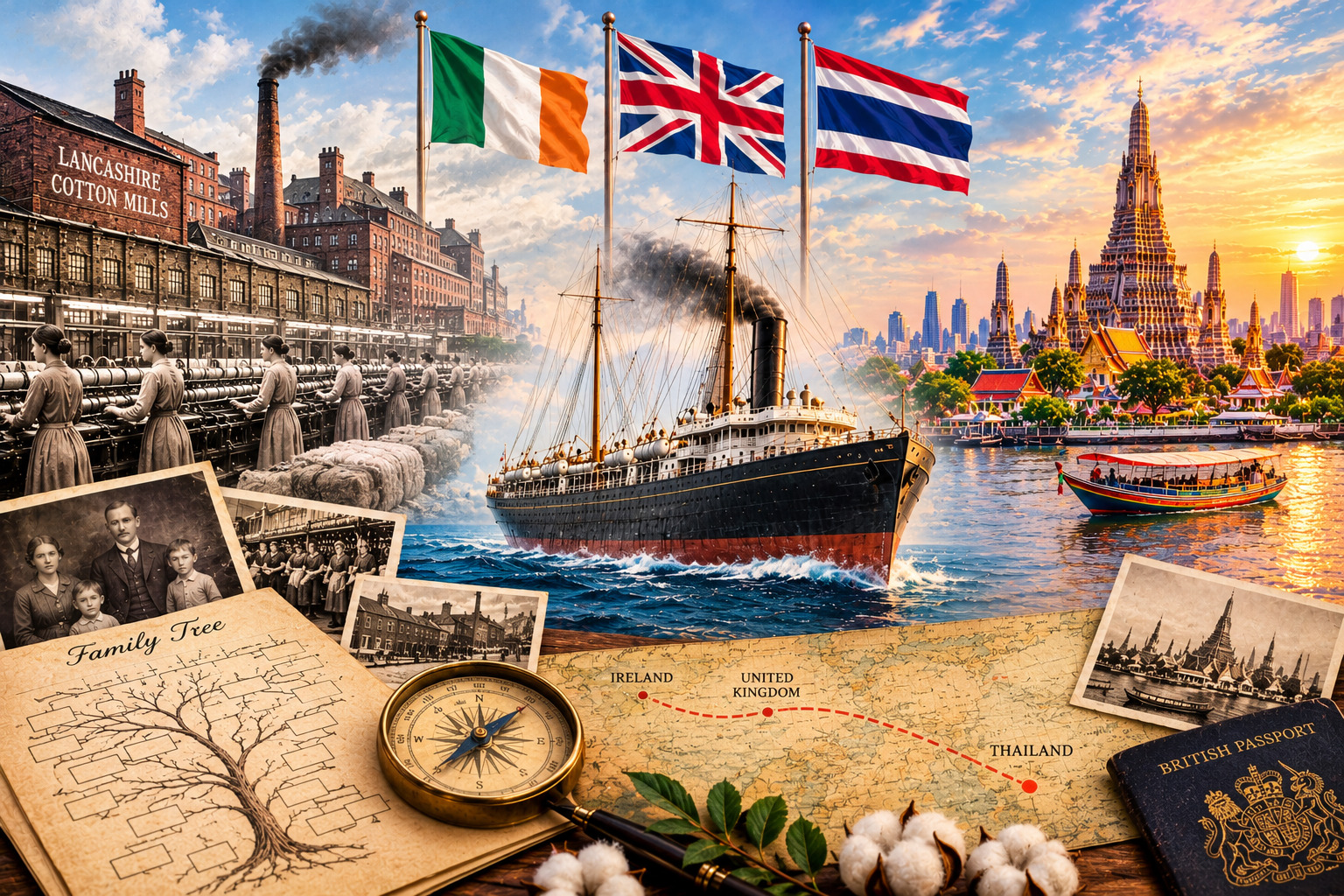
I found out where my family members originated from
I was pretty much able to find relevant details on every family member on the paternal and maternal family lines going back to 1900. Some details on some family members I was not able to find, for instance my maternal grandmother died during WW2, most likely in 1940, but I could find nothing to confirm the details.
From the 1900s, I was to trace my paternal line back to 1801 – I did not bother to trace my maternal line during the 1800s.
I found out my grandfather and my great-grandfather, both called William, were Salfordians; from Salford, the small city next to Manchester.
The first big shock was that my great-great-grandfather, another William (1836–1902), was from Liverpool!
Mancunians, such as my family, and people from Liverpool have a love-hate relationship, with the intense rivalry and complex relationship between Manchester and Liverpool stemming from 19th-century economic competition, cultural proximity, and decades of fierce football rivalry. During the Industrial Revolution, Liverpool served as the primary port for the North of England, handling all the goods and textiles coming out of Manchester’s factories and charging heavy fees for the privilege. Resenting these costs, Manchester engineers and merchants built the Manchester Ship Canal (opened in 1894) to allow ocean-going ships to sail past Liverpool, up the canal and directly in to Manchester’s docks. This severely hurt Liverpool’s port economy and cost thousands of local jobs, creating deep-seated civic bitterness. The football rivalry of Manchester City and Manchester United with Liverpool and Everton is known to most people.
A further and even bigger shock was next up.
My great-great-great grandfather, John Carlile (c1801–at least until 1841), and his wife, Bridget, were both from Ireland, who moved to live first in Liverpool and then Salford in England. Carlile / Carlisle / Carlyle and other spellings originate from the England/Scotland border area around the city of Carlisle, which has been part of Scotland at various times but for a long time is in England. In the late 1700s people were ‘enticed’ from Scotland and the border counties of England to land taken from the native Irish across the Ulster counties of Antrim, Down, Armagh, Derry, Monaghan, Cavan, Tyrone and Donegal. I assume that my relatives were born in the Ulster counties but I could only find the year of their births and not where in Ireland they were born.
So it turns out that I am English or Scottish border -> Irish (probably from the Ulster counties) -> Liverpudlian-> Salfordian – > Mancunian: a bit of a mongrel!
Surname Spellings: Carlile / Carlisle / Carlyle and Pilot / Pilott
As noted above, I surprisingly found out that before the early 1900s, my family surname of Carlisle had been Carlile. In some England Census, my Carlile family members were noted as Carlile, then Carlyle and then back to Carlile in later census; obviously correct spelling of names and people’s documentation of who they were did not seem to be as relevant or strictly adhered to as in modern days.
Another family surname in my maternal line was referred to as either Pilot or Pilott.
So, I asked AI ‘why in the 1800s and 1900s were British and Irish surnames spelt wrong in birth, marriage, death records and in censuses?’, it answered as follows:
The incorrect spelling of British English and Irish surnames in birth, marriage, death records, and census records during the 1800s and 1900s can be attributed to several factors:
Phonetic Recording: Before standardized orthography, clerks, priests, and registrars wrote names as they sounded, using their own spelling conventions and dialects. This resulted in multiple spellings of the same name across different records.
Lack of Literacy: Many individuals, especially in the working class and rural areas, were illiterate or had low literacy rates. This meant they could not correct clerks who misspelled their names or had no fixed idea of the correct spelling.
Accent Variations: Regional accents could amplify the effect, producing different spellings of the same name in different areas. For example, a name pronounced with a long vowel in one county might be written with a short-vowel spelling in another.
Clerical Assumptions: Clerks often wrote names as they heard them, using their own regional accents and spelling conventions. This led to variations in spelling that were not necessarily indicative of a name change.
These factors contributed to the widespread occurrence of spelling variations in these records, making it essential for genealogists to consider these variations when tracing family history.”.
Eight Generations and 105 People Researched
Excluding my brother’s and my children and grandchildren, I researched to some extent eight generations and 105 people in my paternal and maternal line going back to 1801 and then at that point there appears to be a dead-end of information on my Irish ancestors.
The surname Carlile (and its common variants like Carlisle and Carlyle) in Ireland around 1800, was predominantly found in the Province of Ulster. My Great-great-great-grandparents, born in Ireland, likely married in Ireland before taking a ‘packet steamer’ across the Irish Sea to England and the tight-knit Irish community of Liverpool’s dock wards. During the 1820s through the 1840s, Liverpool was the primary gateway for Irish families in to England. My family’s move from Liverpool to Salford locks them in to a precise timeline and geographical track, as in the 19th century, families following this specific route were almost always migrating along the expanding Lancashire railway and canal corridors looking for work in Salford’s booming textile, manufacturing, or iron foundry industries. Salford and Manchester had an abundance of work related to the cotton mills.
The Varied Occupations of My Ancestors
Marriage and Census records include details of people’s occupations and in some cases their employer and employment location. The great majority of my ancestors lived in Salford (Greengate and Broughton) and Manchester (Ancoats, Beswick, Bradford (current home of Manchester City) and Clayton (where Manchester United originated)), and worked in trades (Painter crops up often), or in one of the many cotton mills, or in the heavy industry or colliery works, in typical occupations of those times in Lancashire, as follows:
Bricklayer / Cable maker / candlemaker / carpet weaver / colliery lamp cleaner / copper roller / cotton doffer (doffer stripped full bobbins off spinning frames and replaced them with empty ones, quick work that mills gave to children and young teens) / cotton hooker / cotton sorter / cotton twister/ cotton weaver / cutter / dress machinist / electrical engineer / fent sorter (‘fent’ = remnant of cloth) / fish and chips seller / fishmongers’ assistant / fitter / foundry worker (moulder) / Grocer’s assistant / Hawker / House and ship painter and decorator / Iron puddler / Labourer / Laundry vanman / Layer-on in a cotton mill / Machine driver (strander wire) / Mechanic / Pattern card maker / Plumber / Polisher / Provision shop assistant / Shopworker / Soldier (WW2) / Unpaid domestic duties (i.e. modern-day housewife) / Waiter / Wire diemaker.
Close-Knit Communities: Streets, Work and Family
Once my family moved to Salford / Manchester suburbs, tracking the streets they lived on, which proved difficult as most had been demolished in the 1950s and 1960s slum clearances, it’s apparent that couples who married often lived on the same street or in the same suburb and families would have known each other. There would have been plenty of work for people so there was no need to move out of the suburbs of Manchester they had lived for generations.
How Long Did the Research Take?
The research as noted above was in two phases, first using free websites with BMD records which probably took me 6 hours and the second phase of using Ancestry which took me several days, mainly because by this stage I was enjoying tracing my family genealogy so I kept going back in to Ancestry to search for more and more family members.
Is tracing your family tree easy or difficult?
I guess it depends on the movement of your family.
By that I mean that England has excellent BMD records, and the England Census records every 10 years allows you to trace the movement and changes within a family. Occasionally there will be a family member you really struggle to trace anything relevant upon, could be because they have a very common name, surname recorded incorrectly, or the record of a key event is missing.
I understand that some years of Ireland’s records are not available having been destroyed in a fire.
How Much Did It Cost?
Using free websites was, of course, free.
While I took out an Ancestry subscription for GBP 13 per month, they offer a free 14-day trial which allows you to cancel your subscription (if you cancel two days before the end of the 14-day trial period), so I did my research over several days and then cancelled.
So to research eight generations of my family tree going back to Ireland in 1801 cost me nothing.
Would I Recommend Tracing Your Own Family Tree?
Most definitely, but depending on your interest and your personality traits. My career as a contract manager in construction and engineering meant that I was used to researching information (for claims), analysing the information and preparing reports, so it was ‘right up my street’ but may not be for you.
So how was the experience of tracing my family tree?
For me, the experience was well worth the effort.
I began with a few names on a scrap of paper that I can no longer find and ended up researching 105 people across eight generations, tracing my paternal line back to 1801 and discovering a Liverpool and an Irish chapter in the family story that I had never expected.
There are still unanswered questions, especially about my earliest Irish ancestors, but the research has given me a much clearer picture of where my family came from and how its members lived and worked. It has also left a record that I have shared with my parents, siblings, children and grandchildren — and perhaps one of them one day will research the story further.
If you have ever thought about tracing your own family tree, I would encourage you to give it a try.
Start with what your family already knows, use the free records first, and follow the evidence wherever it leads.
You may be surprised by what you discover.