 Bangkok residents eagerly await the unveiling of the new “gray-silver-blue” Skytrain line
THIS NEWS ARTICLE KINDLY SPONSORED BY FALLPROTEC, A WORLD-RENOWNED NAME IN THE DESIGN AND MANUFACTURE OF PREMIUM FALL PROTECTION SYSTEMS AND HEIGHT ACCESS SOLUTIONS
The Ministry of Transport has taken over the construction of three new electric train lines from the Bangkok Metropolitan Administration (BMA). These three lines include: the Grey Line Phase 1 (Watcharapol–Thonglor), the Silver Line (Bangna–Suvarnabhumi), and the Blue Line (Din Daeng–Sathorn).
Amidst expectations for the “new government” led by Prime Minister Anutin Charnvirakul, who is expected to implement policies aimed at urgently reviving the economy, there is also a need to upgrade infrastructure, particularly “public rail transport,” which is considered a key hope for urban residents. The electric train network is positioned as the central solution to traffic problems and reducing travel costs in the long term.
Currently, the rail network available in Bangkok and its surrounding areas, according to the Mass Rapid Transit Master Plan in Bangkok Metropolitan Region (M-Map), which outlines the development plan for main and secondary mass transit lines over 20 years (2010-2029), comprises more than 279.84 km in total, consisting of 9 colors and 14 lines: Light Green Line (55.80 km), Dark Green Line (14 km), Blue Line (47 km), Purple Line (23 km), Airport Rail Link (28.70 km), Pink Line (37.50 km), Yellow Line (30.40 km), Red Line (41.56 km), and Gold Line (1.88 km).
In addition, there are three more routes currently under construction: the Orange Line East (Cultural Center – Min Buri), scheduled to open in 2028; the Orange Line West (Cultural Center – Bang Khun Non), scheduled to open in 2030; and the Purple Line South (Tao Poon – Rat Burana), also scheduled to open in 2030.
Regarding whether the existing routes cover public transportation needs, it must be said that the current services have greatly improved public travel, but they still lack connectivity between lines. This is a key issue that the Ministry of Transport, under the leadership of Deputy Prime Minister and Minister of Transport, Mr. Pipat Ratchakitprakarn, must urgently address to create more seamless connectivity, whether between the BTS Skytrain systems themselves or between BTS lines and other mass transit modes.
However, it must be acknowledged that the expansion of the rail network, especially the construction of electric trains, will inevitably involve short-term impacts on the public, such as road closures and traffic problems. On the other hand, this is a sign of concrete action beginning to take place under the country’s long-term rail network development plan.
In addition to the existing 9 colors and 14 lines of the electric train system, a clearer picture is beginning to emerge, offering hope to the public who dream of having an expanded electric train network covering even more areas.
The process has begun, as the Ministry of Transport has taken over the construction projects for three new electric train lines from the Bangkok Metropolitan Administration (BMA). These three lines include the Grey Line Phase 1 (Watcharapol–Thonglor), the Silver Line (Bangna–Suvarnabhumi), and the Blue Line (Din Daeng–Sathorn).
Therefore, the “Economic Team” would like to update you on the status of all three projects, outlining their backgrounds and current stages. Most recently, the Cabinet, on February 10, 2026, acknowledged the Cabinet’s resolution No. 1/2024 of December 23, 2024, approving the transfer of responsibility for these new mass transit projects – the Grey Line, the Silver Line, and the Blue Line – from the Bangkok Metropolitan Administration (BMA) to the Ministry of Transport, under the responsibility of the Mass Transit Authority of Thailand (MRTA).
Currently, the Mass Rapid Transit Authority of Thailand (MRTA) is in the process of hiring consultants to review the feasibility of all three projects. As for the implementation plan, design studies are expected to begin in August 2026. Following this, the Ministry of Transport is likely to submit the projects to the Cabinet for approval around 2028, and construction will then proceed with bidding. The lines are projected to be operational in 2033-2034.
Now let’s look at the direction of each of the three routes within Bangkok and see which one is closest to our homes. Let’s start with the Grey Line, Phase 1, from Watcharapol to Thonglor, a distance of 16.30 km with a total of 15 stations. It will be a monorail system.
The route will start from the Ramintra Interchange on Pradit Manutham Road (inbound side), then cross the Chalong Ratch Expressway, and turn left to run on the sidewalk (outbound side) of the Chalong Ratch Expressway (Ekamai-Ramintra Expressway), heading along Pradit Manutham Road, crossing Rama IX Road and the Si Ratch Expressway at the Rama IX-Pradit Manutham intersection. It will then cross the Airport Rail Link, turn right at the Ekkamai North intersection onto the median of Phetchaburi Road, and then turn left onto the median of Thonglor Road for the entire length, ending the project at the entrance of Sukhumvit Soi 55 (Thonglor).
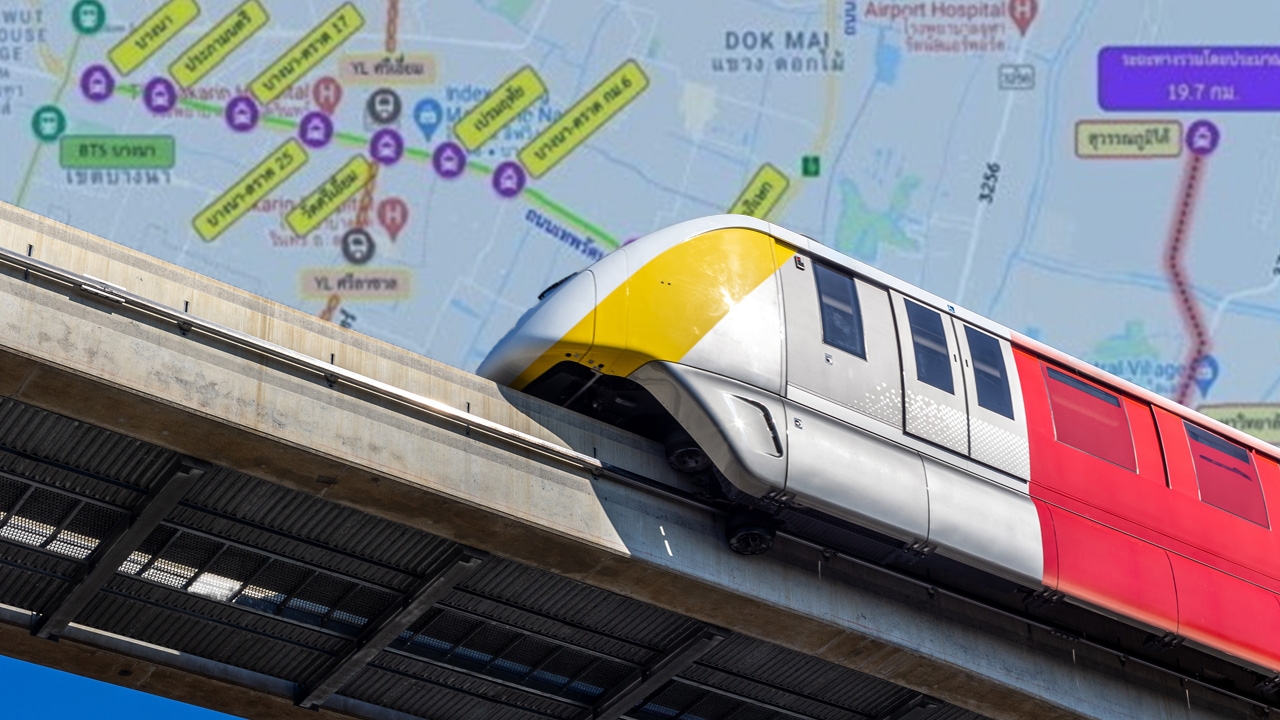
Next, let’s look at the Silver Line, the Bangna-Suvarnabhumi section, spanning 19.70 km with 14 stations. It’s divided into two phases: Phase 1, Bangna-Thana City (14.6 km, 12 stations), and Phase 2, Thana City-Suvarnabhumi South (5.1 km, 2 stations). The train will be a light rail transit (LRT) system. The route starts from Bangna Intersection, following Bangna-Trat Road (Highway 34) on the outbound side until it intersects with Highway 370 (the road leading to Suvarnabhumi Airport from the south), then turns left and continues to Suvarnabhumi Airport on the south side.
The Blue Line project, from Din Daeng to Sathorn, spans 9.5 km with 9 stations and is a monorail system. The route follows Pracha Songkhro Road, Phetchaburi Road, Witthayu Road, and Sathorn Road, connecting the Din Daeng area and key business districts along Sathorn Road to the Makkasan Transportation Hub.
For all three projects, we have to wait and see when and how the government will proceed, given the country’s weak economic conditions. The crucial question, therefore, is not just “will there be new electric train lines?” but “how quickly will the government achieve results?” and “when will the public truly benefit?” Because the hope for Thailand’s rail system today is in a transitional phase, moving from plans on paper to tangible construction.
Source: https://www.thairath.co.th/money/economics/thai_economics/2927023
Google Translation:
ชาวกรุงเทพฯ ต่างตั้งตารอการเปิดตัวรถไฟฟ้าสายใหม่ “เทา-เงิน-น้ำเงิน” อย่างใจจดใจจ่อ
ข่าวนี้ได้รับการสนับสนุนโดย FALLPROTEC บริษัทชั้นนำระดับโลกด้านการออกแบบและผลิตระบบป้องกันการตกจากที่สูงและโซลูชั่นสำหรับการทำงานบนที่สูง
กระทรวงคมนาคมได้เข้ามารับช่วงการก่อสร้างรถไฟฟ้าสายใหม่ 3 สายจากกรุงเทพมหานคร (BMA) ได้แก่ สายสีเทา เฟส 1 (วัชรพล-ทองหล่อ) สายสีเงิน (บางนา-สุวรรณภูมิ) และสายสีน้ำเงิน (ดินแดง-สาทร)
ท่ามกลางความคาดหวังต่อ “รัฐบาลใหม่” นำโดยนายกรัฐมนตรี อนุทิน ชาญวีรกุล ที่คาดว่าจะดำเนินนโยบายเพื่อฟื้นฟูเศรษฐกิจอย่างเร่งด่วน ยังมีความจำเป็นในการยกระดับโครงสร้างพื้นฐาน โดยเฉพาะ “ระบบขนส่งทางราง” ซึ่งถือเป็นความหวังสำคัญของชาวเมือง เครือข่ายรถไฟฟ้าถูกวางตำแหน่งให้เป็นทางออกหลักในการแก้ปัญหาการจราจรและลดค่าใช้จ่ายในการเดินทางในระยะยาว
ปัจจุบัน เครือข่ายรถไฟฟ้าในกรุงเทพฯ และพื้นที่โดยรอบ ตามแผนแม่บทรถไฟฟ้าขนส่งมวลชนในกรุงเทพมหานคร (M-Map) ซึ่งกำหนดแผนพัฒนาเส้นทางรถไฟฟ้าสายหลักและสายรองในระยะเวลา 20 ปี (2010-2029) มีระยะทางรวมกว่า 279.84 กิโลเมตร ประกอบด้วย 9 สี และ 14 สาย ได้แก่ สายสีเขียวอ่อน (55.80 กม.) สายสีเขียวเข้ม (14 กม.) สายสีน้ำเงิน (47 กม.) สายสีม่วง (23 กม.) สายแอร์พอร์ตเรลลิงก์ (28.70 กม.) สายสีชมพู (37.50 กม.) สายสีเหลือง (30.40 กม.) สายสีแดง (41.56 กม.) และสายสีทอง (1.88 กม.)
นอกจากนี้ ยังมีอีก 3 เส้นทางที่อยู่ระหว่างการก่อสร้าง ได้แก่ สายสีส้มตะวันออก (ศูนย์วัฒนธรรม – มีนบุรี) ซึ่งมีกำหนดเปิดให้บริการในปี 2028; สายสีส้มตะวันตก (ศูนย์วัฒนธรรม – บางขุนนนท์) มีกำหนดเปิดให้บริการในปี 2573 และสายสีม่วงใต้ (เต้าพูน – รัตน์บูรณะ) ก็มีกำหนดเปิดให้บริการในปี 2573 เช่นกัน
ส่วนเรื่องว่าเส้นทางที่มีอยู่เพียงพอต่อความต้องการด้านการขนส่งสาธารณะหรือไม่นั้น ต้องยอมรับว่าบริการในปัจจุบันได้ช่วยยกระดับการเดินทางของประชาชนไปมากแล้ว แต่ยังขาดการเชื่อมต่อระหว่างสายต่างๆ นี่เป็นประเด็นสำคัญที่กระทรวงคมนาคม ภายใต้การนำของรองนายกรัฐมนตรีและรัฐมนตรีว่าการกระทรวงคมนาคม นายพิพัฒน์ รัชกิจประการ ต้องเร่งแก้ไขเพื่อสร้างการเชื่อมต่อที่ราบรื่นยิ่งขึ้น ไม่ว่าจะเป็นระหว่างระบบรถไฟฟ้า BTS ด้วยกันเอง หรือระหว่างสายรถไฟฟ้า BTS กับระบบขนส่งมวลชนอื่นๆ
อย่างไรก็ตาม ต้องยอมรับว่าการขยายเครือข่ายรถไฟ โดยเฉพาะการสร้างรถไฟฟ้า จะส่งผลกระทบต่อประชาชนในระยะสั้นอย่างหลีกเลี่ยงไม่ได้ เช่น การปิดถนนและปัญหาการจราจร แต่ในอีกด้านหนึ่ง นี่ก็เป็นสัญญาณของการดำเนินการที่เป็นรูปธรรมที่เริ่มขึ้นภายใต้แผนพัฒนาเครือข่ายรถไฟระยะยาวของประเทศ
นอกจากระบบรถไฟฟ้าที่มีอยู่แล้ว 9 สี 14 สาย ภาพรวมเริ่มชัดเจนขึ้น ซึ่งสร้างความหวังให้กับประชาชนที่ใฝ่ฝันอยากมีเครือข่ายรถไฟฟ้าที่ครอบคลุมพื้นที่มากขึ้น
กระบวนการได้เริ่มต้นขึ้นแล้ว เนื่องจากกระทรวงคมนาคมได้เข้ามารับช่วงโครงการก่อสร้างรถไฟฟ้า 3 สายใหม่จากกรุงเทพมหานคร (กรุงเทพมหานคร) ซึ่งได้แก่ สายสีเทา เฟส 1 (วัชรพล-ทองหล่อ) สายสีเงิน (บางนะ-สุวรรณภูมิ) และสายสีน้ำเงิน (ดินแดง-สาทร)
ดังนั้น “ทีมเศรษฐกิจ” จึงขอแจ้งความคืบหน้าของทั้งสามโครงการ โดยชี้แจงถึงความเป็นมาและขั้นตอนปัจจุบัน ล่าสุด เมื่อวันที่ 10 กุมภาพันธ์ 2569 คณะรัฐมนตรีได้อนุมัติมติคณะรัฐมนตรีฉบับที่ 1/2024 ลงวันที่ 23 ธันวาคม 2567 อนุมัติการโอนความรับผิดชอบโครงการรถไฟฟ้าขนส่งมวลชนสายใหม่ ได้แก่ สายสีเทา สายสีเงิน และสายสีน้ำเงิน จากกรุงเทพมหานคร (BMA) ไปยังกระทรวงคมนาคม ภายใต้การกำกับดูแลของ การรถไฟฟ้าขนส่งมวลชนแห่งประเทศไทย (MRTA)
ปัจจุบัน การรถไฟฟ้าขนส่งมวลชนแห่งประเทศไทย (MRTA) กำลังดำเนินการว่าจ้างที่ปรึกษาเพื่อตรวจสอบความเป็นไปได้ของทั้งสามโครงการ สำหรับแผนการดำเนินงาน คาดว่าจะเริ่มการศึกษาด้านการออกแบบในเดือนสิงหาคม 2569 หลังจากนั้น กระทรวงคมนาคมน่าจะเสนอโครงการต่อคณะรัฐมนตรีเพื่อขออนุมัติประมาณปี 2561 และจะดำเนินการก่อสร้างโดยเปิดประมูลต่อไป คาดว่าจะเปิดให้บริการได้ในปี 2576-2567
ต่อไปนี้เราจะมาดูเส้นทางของรถไฟฟ้าทั้งสามสายในกรุงเทพฯ และดูว่าสายไหนใกล้บ้านเราที่สุด เริ่มจากสายสีเทา เฟส 1 จากวัชรพล ถึง ทองหล่อ ระยะทาง 16.30 กิโลเมตร มีทั้งหมด 15 สถานี เป็นระบบรถไฟฟ้าโมโนเรล
เส้นทางจะเริ่มต้นจากทางแยกรามอินทรา บนถนนประดิษฐ์มณุธรรม (ขาเข้า) จากนั้นข้ามทางด่วนฉลองราช และเลี้ยวซ้ายวิ่งบนทางเท้า (ขาออก) ของทางด่วนฉลองราช (ทางด่วนเอกมัย-รามอินทรา) ไปตามถนนประดิษฐ์มณุธรรม ข้ามถนนพระราม 9 และทางด่วนศรีราช ที่ทางแยกพระราม 9-ประดิษฐ์มณุธรรม จากนั้นจะข้ามทางรถไฟแอร์พอร์ตเรลลิงก์ เลี้ยวขวาที่สี่แยกเอกมัยเหนือ เข้าสู่เกาะกลางถนนเพชรบุรี แล้วเลี้ยวซ้ายเข้าสู่เกาะกลางถนนทองหล่อตลอดเส้นทาง จนสิ้นสุดโครงการที่ทางเข้าซอยสุขุมวิท 55 (ทองหล่อ)
ต่อไป เรามาดูสายสีเงิน ส่วนบางนา-สุวรรณภูมิ ระยะทาง 19.70 กิโลเมตร มี 14 สถานี แบ่งออกเป็นสองเฟส คือ เฟส 1 บางนา-ธานีซิตี้ (14.6 กิโลเมตร 12 สถานี) และเฟส 2 ธานีซิตี้-สุวรรณภูมิใต้ (5.1 กิโลเมตร 2 สถานี) รถไฟฟ้าจะเป็นระบบรถไฟฟ้ารางเบา (LRT) เส้นทางเริ่มต้นจากสี่แยกบางนา วิ่งตามถนนบางนา-ตราด (ทางหลวงหมายเลข 34) ฝั่งขาออก จนตัดกับทางหลวงหมายเลข 370 (ถนนที่มุ่งหน้าสู่สนามบินสุวรรณภูมิจากทางใต้) จากนั้นเลี้ยวซ้ายและวิ่งต่อไปยังสนามบินสุวรรณภูมิทางฝั่งใต้
โครงการรถไฟฟ้าสายสีน้ำเงิน จากดินแดงถึงสาทร มีความยาว 9.5 กิโลเมตร มี 9 สถานี เป็นระบบรถไฟฟ้ารางเดี่ยว เส้นทางวิ่งผ่านถนนประชาสงเคราะห์ ถนนเพชรบุรี ถนนวิทยุ และถนนสาทร เชื่อมต่อพื้นที่ดินแดงและย่านธุรกิจสำคัญตามแนวถนนสาทรไปยังศูนย์กลางการคมนาคมมักกะสัน
สำหรับทั้งสามโครงการ เราต้องรอดูว่ารัฐบาลจะดำเนินการอย่างไรและเมื่อไหร่ เนื่องจากภาวะเศรษฐกิจของประเทศไม่เอื้ออำนวย คำถามสำคัญจึงไม่ใช่แค่ “จะมีรถไฟฟ้าสายใหม่หรือไม่?” แต่เป็น “รัฐบาลจะดำเนินการได้เร็วแค่ไหน?” และ “ประชาชนจะได้รับประโยชน์อย่างแท้จริงเมื่อไหร่?” เพราะความหวังสำหรับระบบรถไฟของประเทศไทยในปัจจุบันอยู่ในช่วงเปลี่ยนผ่าน จากแผนงานบนกระดาษไปสู่การก่อสร้างที่เป็นรูปธรรม