
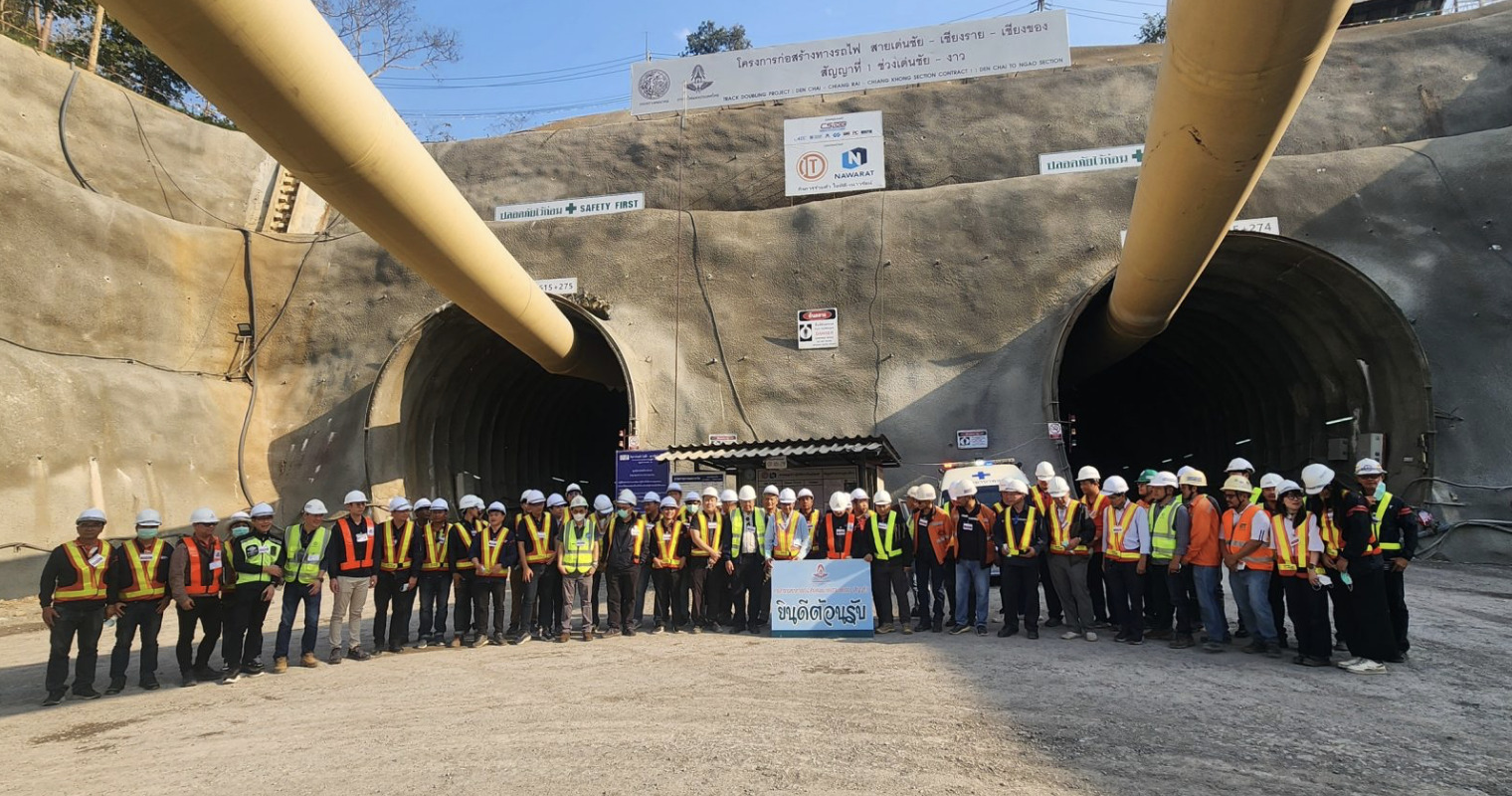
Thailand milestone on 6.2km Ngao railway tunnel, the country’s longest railway tunnel, on new 323km Den Chai–Chiang Rai–Chiang Khong railway
THIS NEWS ARTICLE KINDLY SPONSORED BY FALLPROTEC, A WORLD-RENOWNED NAME IN THE DESIGN AND MANUFACTURE OF PREMIUM FALL PROTECTION SYSTEMS AND HEIGHT ACCESS SOLUTIONS
Thailand’s State Railway of Thailand (SRT) has marked a major excavation milestone on the 6.2km-long Ngao railway tunnel, the country’s longest railway tunnel, which forms part of the new 323km Den Chai–Chiang Rai–Chiang Khong railway.
A ceremonial breakthrough was held on 11 November at the tunnel site in Lampang province, attended by Deputy Prime Minister and Minister of Transport Phiphat Ratchakitprakarn and senior SRT officials.
Although the ceremony marked a significant construction milestone, 24.3m of excavation remains, with completion scheduled for December 2026.
The 6,215m-long tunnel comprises twin single-track bores and forms part of the US$820M Contract 1, covering the 103km Den Chai–Ngao section of the railway. The contract is being undertaken by a joint venture of Italian-Thai Development (ITD) and Nawarat Patanakarn, with specialist tunnelling contractor Right Tunnelling also involved in the package.
The tunnel passes through mountainous terrain containing complex geological formations, including thickly bedded limestone and ancient volcanic ash deposits.
Excavation began in December 2023, with construction accelerated through the use of an intermediate access adit, reported by SRT as having a diameter of 8.5m. Located near the centre of the alignment, the adit provides two additional excavation faces, allowing tunnelling to proceed simultaneously from multiple locations.
The arrangement divides the main tunnel into southern and northern sections measuring approximately 3,831m and 2,384m respectively.
A technical study published in SRT’s Permanent Way Engineer Journal confirms that the intermediate adit was excavated using NATM, combining drill-and-blast with hydraulic breakers according to ground conditions. Excavation sequences included full-face and top-heading-and-bench methods, with shotcrete and ground support installed as work progressed.
The study also identified significant geological challenges, including fault zones and groundwater ingress, which contributed to five roof-collapse incidents during construction of the adit. As a result, excavation of the access tunnel took seven months, compared with the originally planned three months.
Following completion of the main tunnel excavation, work will continue on the internal structures, railway systems and safety installations, ahead of testing and commissioning.
The Ngao tunnel is a key element of the 323.1km Den Chai–Chiang Rai–Chiang Khong railway, which will connect four northern provinces and provide a new rail corridor towards Thailand’s border with Laos.
According to SRT, overall construction progress on the railway reached 74.076% at the end of October 2026. Progress on the three construction contracts stood at 75.898% for Den Chai–Ngao, 75.124% for Ngao–Chiang Rai and 70.125% for Chiang Rai–Chiang Khong.
The railway is scheduled to open in 2028, providing additional passenger and freight capacity and improving cross-border transport connections.
Source: https://tunnellingjournal.com/thailand-milestone-on-6-2km-ngao-railway-tunnel/
ความคืบหน้าครั้งสำคัญของอุโมงค์รถไฟ “งาว” ในประเทศไทย ซึ่งเป็นอุโมงค์รถไฟที่ยาวที่สุดในประเทศ โดยเป็นส่วนหนึ่งของโครงการรถไฟสายใหม่ช่วงเด่นชัย–เชียงราย–เชียงของ ระยะทาง 323 กิโลเมตร
บทความข่าวนี้ได้รับการสนับสนุนโดย FALLPROTEC แบรนด์ระดับโลกที่มีชื่อเสียงด้านการออกแบบและผลิตระบบป้องกันการตกจากที่สูงและโซลูชันสำหรับการเข้าถึงพื้นที่สูงที่มีคุณภาพระดับพรีเมียม
การรถไฟแห่งประเทศไทย (รฟท.) ได้บรรลุความคืบหน้าครั้งสำคัญในการขุดเจาะอุโมงค์รถไฟ “งาว” ซึ่งมีความยาว 6.2 กิโลเมตร ถือเป็นอุโมงค์รถไฟที่ยาวที่สุดในประเทศไทย โดยเป็นส่วนหนึ่งของโครงการรถไฟสายใหม่ช่วงเด่นชัย–เชียงราย–เชียงของ ระยะทาง 323 กิโลเมตร
พิธีฉลองความสำเร็จในการทะลุอุโมงค์จัดขึ้นเมื่อวันที่ 11 พฤศจิกายน ณ พื้นที่ก่อสร้างอุโมงค์ในจังหวัดลำปาง โดยมีนายพิพัฒน์ รัชกิจประการ รองนายกรัฐมนตรีและรัฐมนตรีว่าการกระทรวงคมนาคม พร้อมด้วยผู้บริหารระดับสูงของการรถไฟแห่งประเทศไทยเข้าร่วมในพิธี
แม้พิธีดังกล่าวจะเป็นการเฉลิมฉลองความสำเร็จครั้งสำคัญในการก่อสร้าง แต่ยังคงเหลือระยะทางการขุดเจาะอีก 24.3 เมตร โดยมีกำหนดการก่อสร้างแล้วเสร็จภายในเดือนธันวาคม พ.ศ. 2569
อุโมงค์แห่งนี้มีความยาวรวม 6,215 เมตร ประกอบด้วยอุโมงค์เดี่ยวคู่ขนานกัน (Twin single-track bores) และเป็นส่วนหนึ่งของสัญญาที่ 1 ซึ่งมีมูลค่าโครงการ 820 ล้านดอลลาร์สหรัฐ ครอบคลุมเส้นทางช่วงเด่นชัย–งาว ระยะทาง 103 กิโลเมตร โดยสัญญาดังกล่าวเป็นการดำเนินงานร่วมกันระหว่างบริษัท อิตาเลียนไทย ดีเวล๊อปเมนต์ จำกัด (มหาชน) (ITD) และบริษัท นวรัตน์พัฒนาการ จำกัด (มหาชน) ร่วมด้วยบริษัท ไรท์ทัลเนลลิ่ง จำกัด (Right Tunnelling) ซึ่งเป็นผู้เชี่ยวชาญด้านงานขุดเจาะอุโมงค์
แนวอุโมงค์ตัดผ่านพื้นที่ภูเขาที่มีโครงสร้างทางธรณีวิทยาซับซ้อน ประกอบด้วยชั้นหินปูนหนาและชั้นเถ้าภูเขาไฟโบราณ
การขุดเจาะเริ่มต้นขึ้นในเดือนธันวาคม พ.ศ. 2566 โดยมีการเร่งรัดการก่อสร้างด้วยการสร้างอุโมงค์ทางเข้าชั่วคราว (Intermediate access adit) ซึ่งการรถไฟแห่งประเทศไทยระบุว่ามีเส้นผ่านศูนย์กลาง 8.5 เมตร อุโมงค์ทางเข้านี้ตั้งอยู่ใกล้กับบริเวณกึ่งกลางของแนวเส้นทาง ช่วยเพิ่มจุดเริ่มต้นการขุดเจาะอีก 2 จุด ทำให้สามารถดำเนินการขุดเจาะอุโมงค์ไปพร้อมกันได้จากหลายตำแหน่ง การออกแบบนี้แบ่งอุโมงค์หลักออกเป็นส่วนทางทิศใต้และทิศเหนือ โดยมีความยาวประมาณ 3,831 เมตร และ 2,384 เมตร ตามลำดับ
ผลการศึกษาทางเทคนิคที่ตีพิมพ์ในวารสารวิศวกรทางรถไฟ (Permanent Way Engineer Journal) ของการรถไฟแห่งประเทศไทย (รฟท.) ระบุว่า อุโมงค์เชื่อมต่อระหว่างทาง (intermediate adit) ถูกขุดเจาะโดยใช้วิธี NATM (New Austrian Tunnelling Method) ซึ่งเป็นการผสมผสานระหว่างการเจาะและระเบิดหินกับการใช้หัวกระแทกไฮดรอลิกตามสภาพของชั้นดินและหิน โดยมีขั้นตอนการขุดเจาะทั้งแบบเต็มหน้าตัด (full-face) และแบบแบ่งขุดส่วนบนก่อนแล้วจึงขุดส่วนล่าง (top-heading-and-bench) พร้อมทั้งมีการพ่นคอนกรีต (shotcrete) และติดตั้งระบบค้ำยันระหว่างการดำเนินงาน
ผลการศึกษายังระบุถึงความท้าทายทางธรณีวิทยาที่สำคัญ เช่น แนวรอยเลื่อนและการไหลซึมของน้ำใต้ดิน ซึ่งส่งผลให้เกิดเหตุการณ์เพดานอุโมงค์ถล่มระหว่างการก่อสร้างอุโมงค์เชื่อมต่อนี้ถึง 5 ครั้ง ส่งผลให้การขุดเจาะอุโมงค์ทางเข้าดังกล่าวใช้เวลาถึง 7 เดือน จากเดิมที่วางแผนไว้เพียง 3 เดือน
หลังจากเสร็จสิ้นการขุดเจาะอุโมงค์หลักแล้ว งานในขั้นตอนต่อไปจะครอบคลุมถึงการก่อสร้างโครงสร้างภายใน ระบบราง และระบบความปลอดภัย ก่อนที่จะเข้าสู่ขั้นตอนการทดสอบและการเปิดใช้งานจริง
อุโมงค์งาวถือเป็นส่วนสำคัญของโครงการรถไฟสายเด่นชัย–เชียงราย–เชียงของ ระยะทาง 323.1 กิโลเมตร ซึ่งจะเชื่อมต่อจังหวัดต่าง ๆ ในภาคเหนือ 4 จังหวัดเข้าด้วยกัน และสร้างเส้นทางรถไฟสายใหม่ที่มุ่งสู่บริเวณชายแดนไทย–ลาว
ข้อมูลจากการรถไฟแห่งประเทศไทยระบุว่า ณ สิ้นเดือนตุลาคม 2026 ความคืบหน้าโดยรวมของการก่อสร้างทางรถไฟสายนี้อยู่ที่ 74.076% โดยแบ่งเป็นสัญญาการก่อสร้าง 3 สัญญา ได้แก่ ช่วงเด่นชัย–งาว มีความคืบหน้า 75.898%, ช่วงงาว–เชียงราย มีความคืบหน้า 75.124% และช่วงเชียงราย–เชียงของ มีความคืบหน้า 70.125%
ทั้งนี้ โครงการรถไฟดังกล่าวมีกำหนดเปิดให้บริการในปี 2028 ซึ่งจะช่วยเพิ่มขีดความสามารถในการรองรับผู้โดยสารและสินค้า รวมถึงยกระดับการเชื่อมต่อด้านการขนส่งข้ามพรมแดนให้ดียิ่งขึ้น
[English to Thai translation by Google Translation: We apologise if any of the Google translation is incorrect]


