 Bangkok Post Editorial – Rethink Thailand’s Land Bridge project
THIS NEWS ARTICLE KINDLY SPONSORED BY FALLPROTEC , A WORLD-RENOWNED NAME IN THE DESIGN AND MANUFACTURE OF PREMIUM FALL PROTECTION SYSTEMS AND HEIGHT ACCESS SOLUTIONS
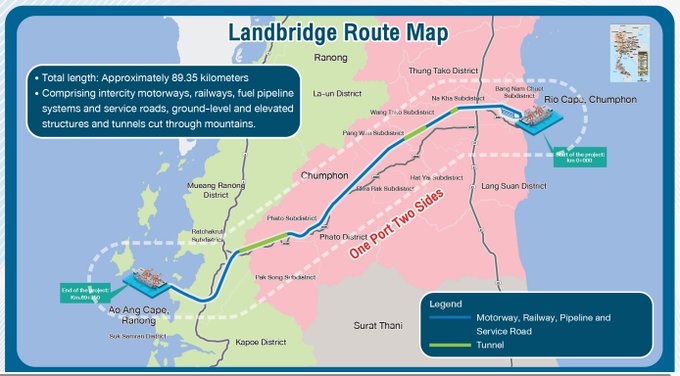
Prime Minister Anutin Charnvirakul has made the right decision to review the feasibility study for the proposed Land Bridge project.
While the move portrays the Anutin 2.0 administration as open and conciliatory, the review will not lead to productive consultation or informed decision-making as long as the government continues to rely on the feasibility study conducted by the Office of Transport and Traffic Policy and Planning (OTP).
The OTP is a think-tank agency under the Transport Ministry. The office hired local consulting firms to conduct the initial feasibility study in 2021 and an updated version in 2023.
The OTP’s study is insufficient for policymakers to decide on an international mega-logistics project. The scheme requires at least 1 trillion baht in investment, not to mention large-scale land relocation that would affect local communities.
Such an international project requires experienced professionals to study all aspects, including international logistics, business law, investment and, of course, the environmental impact. It also needs credible institutions and neutral academic researchers to take part in the process to address criticism and opposition.
That is not the case with the OTP’s studies, which governments have treated almost as a bible guiding their decisions. The feasibility study presents only a basic conceptual design, preliminary environmental impact assessments and a business model. The OTP hired local consulting firms — most of them experienced in developing public infrastructure such as reservoirs, irrigation systems and transport projects — to conduct the study.
Critics have questioned why governments have not funded more in-depth studies to gather broader information. Indeed, the Office of the National Economic and Social Development Council (NESDC), the national think-tank, commissioned Chulalongkorn University to review whether the OTP’s study was accurate and to compare the project with competing logistics corridors and ports in Myanmar.
The NESDC’s study painted a different picture, suggesting much lower economic returns and questioning the project’s economic feasibility. It raises the question of why governments have paid so little attention to the NESDC’s findings. After all, the national think tank is responsible for drafting the country’s master plans, while UniSearch, a research unit under Chulalongkorn University, has frequently been commissioned by governments and state enterprises to conduct studies.
The key question now is what the Anutin 2.0 administration will do with the review. It is dismaying that the government appears likely to repeat the same approach by relying again on OTP rather than commissioning a new study or integrating the NESDC’s findings into the decision-making process. The government committee has been given just 90 days to complete the review.
With a centralized and non-inclusive committee, it is likely that the Anutin 2.0 government will produce only the “OTP’s Land Bridge Study Version 3”, which may differ little from earlier versions that painted an overly rosy picture.
It is not too late for Mr Anutin to backpedal. Instead of rushing the project, he should commission a more comprehensive study so the government can make an informed decision. No one should gamble on a project just because it appears possible. Yet that seems to be exactly what this government is preparing to do.
These editorials represent Bangkok Post thoughts about current issues and situations.
Source: https://www.bangkokpost.com/opinion/opinion/3251538/rethink-the-land-bridge
Google Translation:
This news article is sponsored by FALLPROTEC, a world-renowned company specializing in the design and manufacture of premium fall protection systems and high-altitude access solutions.
Bangkok Post Editorial – Reviewing Thailand’s Land Bridge Project
Prime Minister Anutin Charnvirakul made the right decision to review the feasibility study of the proposed land bridge project.
Although such actions demonstrate a more open and conciliatory approach to the Anutin 2.0 government, the review will not lead to effective consultation or informed decision-making as long as the government continues to rely on feasibility studies conducted by the Office of Transport Policy and Planning (OTP).
OTP is a research agency under the Ministry of Transport. The agency commissioned a domestic consulting firm to conduct an initial feasibility study in 2021 and an updated version in 2023.
The OTP study is insufficient for policymakers to make decisions about large-scale international logistics projects. These projects require at least 1 trillion baht in investment, not including the massive land relocation that will impact local communities.
International projects like this require experienced experts to study all aspects, including international logistics, business law, investment, and of course, environmental impact. Furthermore, it needs credible institutions and impartial academic researchers to participate in the process to address criticism and objections.
But this case is different. The OTP study, which the government used as a guide for decision-making, presented only basic conceptual design, preliminary environmental impact assessments, and business models. OTP hired local consulting firms, mostly with experience in developing public infrastructure such as reservoirs, irrigation systems, and transportation projects, to conduct the study.
Critics question why the government hasn’t funded more in-depth studies to gather broader data. Indeed, the National Economic and Social Development Council (NESDC), the country’s research agency, commissioned Chulalongkorn University to verify the validity of the OTP study and compare the project to competing logistics corridors and ports in Myanmar.
The NESDC study, however, presented a different picture, pointing to significantly lower economic returns and questioning the project’s economic feasibility. This raises the question of why the government paid so little attention to the NESDC study results, given that the national research agency is responsible for drafting national master plans, while UniSearch, a research unit under Chulalongkorn University, is frequently commissioned by the government and state enterprises to conduct studies.
The crucial question now is how Prime Minister Anutin’s second government will proceed with this review. It’s disappointing that the government seems to be using the same approach, relying on OTP again, instead of commissioning a new study or incorporating the NESDC’s findings into its decision-making. The government committee has only 90 days to complete the review.
With a centralized and closed committee, the Anutin 2.0 government is likely to produce only a “Third OTP Bridge Study Report,” which may differ only slightly from the overly optimistic previous versions.
It’s not too late for Mr. Anutin to back down. Instead of rushing the project, he should order a more comprehensive study so that the government can make a well-informed decision. No one should risk a project simply because it seems feasible, but it appears this government is preparing to do just that.
These editorial articles represent Bangkok Post’s viewpoint on current issues and situations.