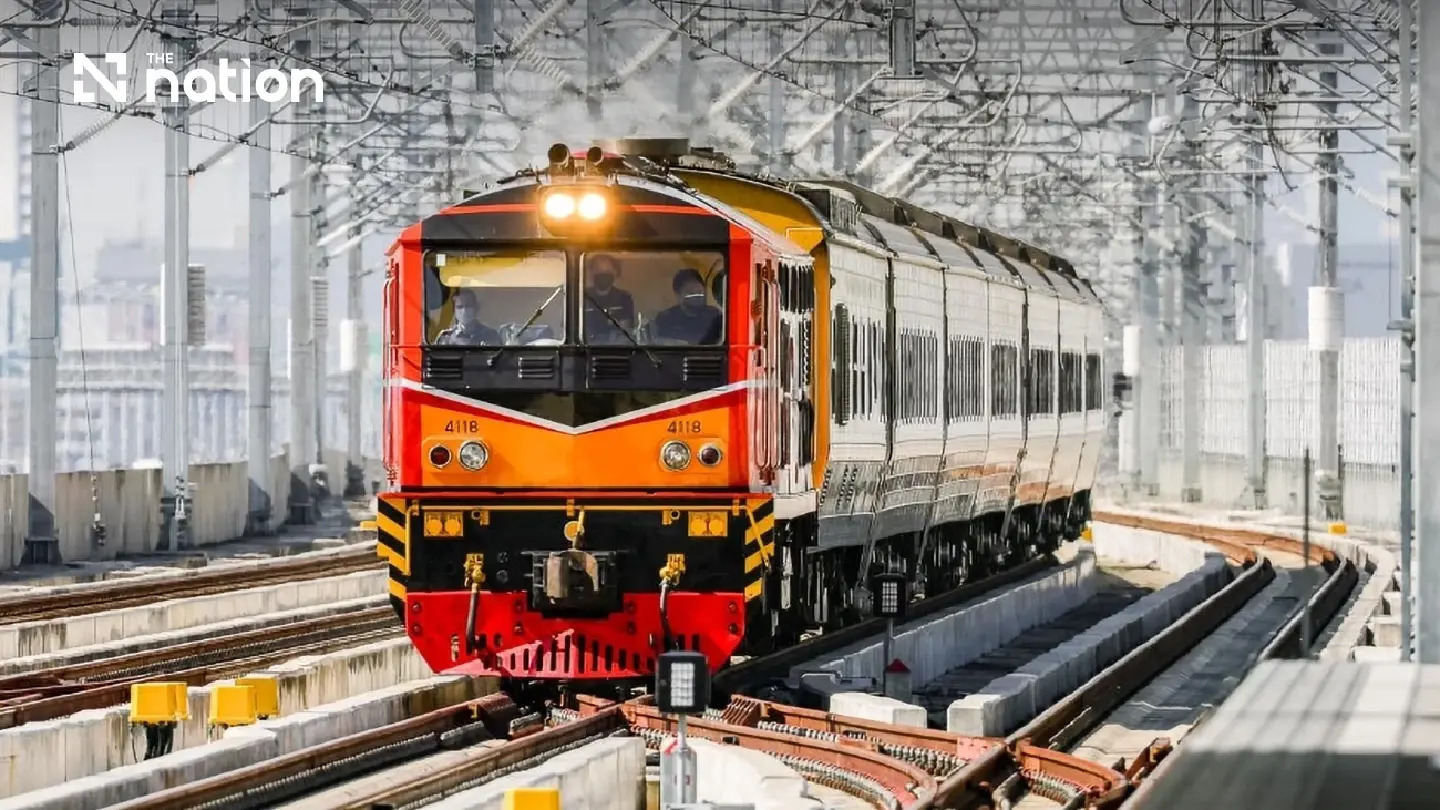
 Thailand’s Transport Ministry to seek Cabinet approval for 504km, 106.8-billion-baht southern double-track railway to Padang Besar
The Transport Ministry will seek Cabinet approval on September 1 for a 504km, 106.8-billion-baht southern double-track railway to Padang Besar.
THIS NEWS ARTICLE KINDLY SPONSORED BY FALLPROTEC, A WORLD-RENOWNED NAME IN THE DESIGN AND MANUFACTURE OF PREMIUM FALL PROTECTION SYSTEMS AND HEIGHT ACCESS SOLUTIONS
The Transport Ministry is preparing to seek Cabinet approval on September 1 for a 504-kilometre first phase of its southern double-track railway programme, involving an investment framework of about 106.8 billion baht and extending the network to Padang Besar on the Malaysian border.
The proposal is expected to be considered at the mobile Cabinet meeting in Songkhla after the State Railway of Thailand (SRT) board approved the implementation approach for three Phase 2 southern routes covering a combined 534km.
Deputy Transport Minister Sanphet Bunyamanee said on Sunday (August 16) that the SRT was finalising the project details for submission to the Transport Ministry within the week before proceeding through the remaining approval process.
The initial construction programme would cover 504km, while the remaining 30km between Hat Yai Junction and Songkhla would be considered in a later phase rather than removed from the plan.
First phase covers three southern corridors
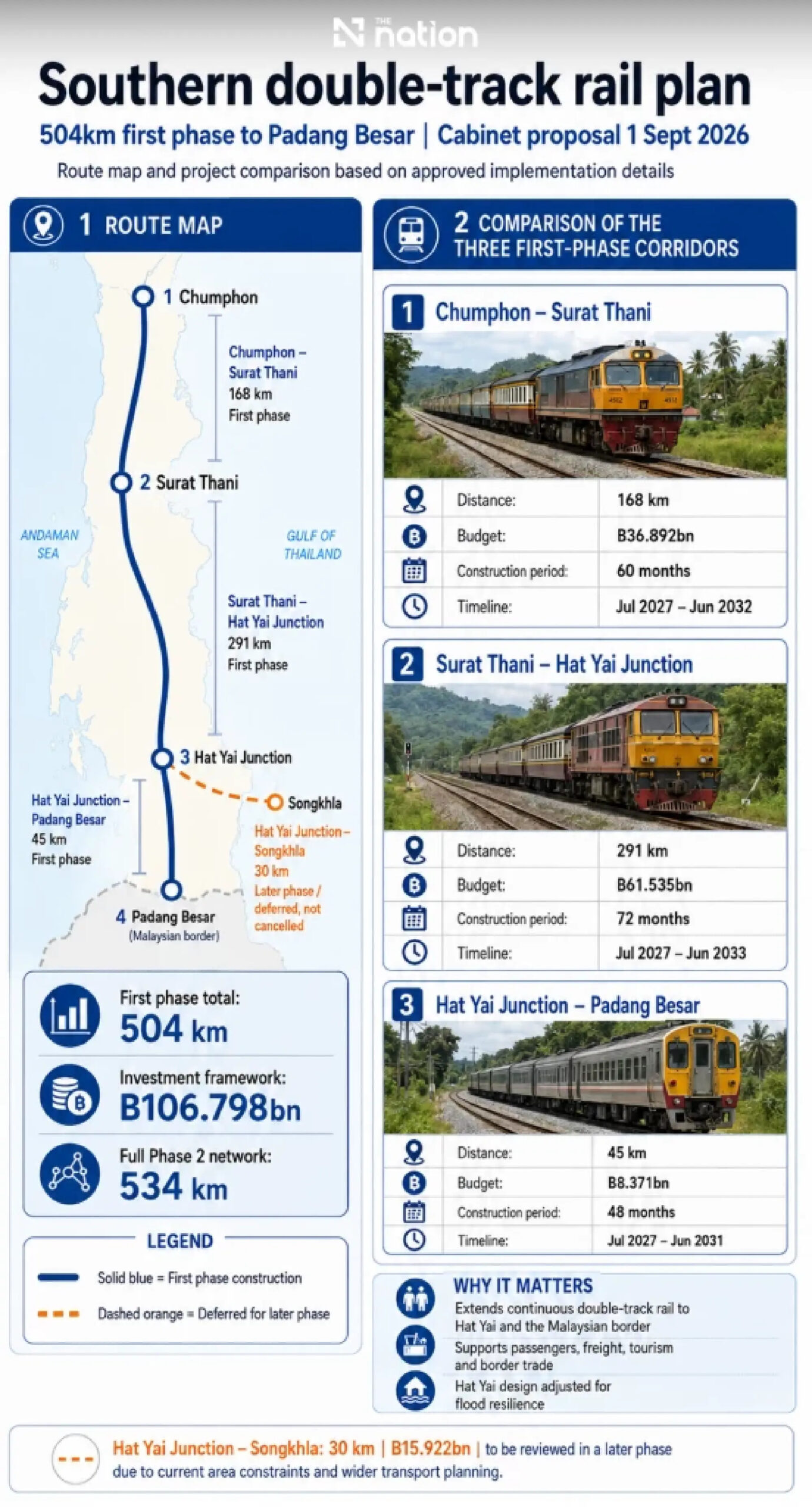
The full Phase 2 programme comprises three routes totalling 534km:
- Chumphon–Surat Thani, covering 168km
- Surat Thani–Hat Yai Junction–Songkhla, covering 321km
- Hat Yai Junction–Padang Besar, covering 45km
Construction would begin with the entire 168km Chumphon–Surat Thani section, the 291km Surat Thani–Hat Yai Junction section and the 45km Hat Yai Junction–Padang Besar section.
These three corridors would form the 504km first phase, with a combined investment framework of approximately 106.798 billion baht.
The project would extend continuous double-track operations from the upper South through Hat Yai to Padang Besar, a key gateway connecting Thailand’s railway system with Malaysia.
The expanded network is intended to support passenger journeys, tourism, border trade and international freight while easing the operational constraints of the existing single-track railway.
“Once the double-track network extends from the upper South to Hat Yai and Padang Besar, it will increase capacity for passenger and freight services, reduce single-track limitations, improve transport efficiency and connect the southern economy more effectively with neighbouring countries,” Sanphet said.
Hat Yai alignment redesigned after floods
Parts of the railway around Hat Yai have been redesigned following flooding in November 2025 that disrupted the southern line.
Around 3km of railway previously planned at ground level would instead be built as an elevated viaduct, while a further 2km would use an embankment structure.
The revised design is intended to improve flood resilience, reduce obstruction to natural waterways and lower the risk of the southern rail network being damaged or cut off during future floods.
Sanphet said the investment should address long-term local conditions as well as increase rail capacity.
Hat Yai is a major economic, commercial, tourism and transport centre for southern Thailand, making it necessary to incorporate lessons from previous flooding into the new infrastructure design, he added.
Construction planned from July 2027
The 168km Chumphon–Surat Thani section has a revised investment framework of 36.89232 billion baht.
Construction is expected to take about 60 months, or five years, from July 2027 to June 2032.
The wider 321km Surat Thani–Hat Yai Junction–Songkhla corridor has a revised investment framework of 77.45697 billion baht. However, only the 291km Surat Thani–Hat Yai Junction section would proceed in the first phase.
That section has a budget framework of 61.53455 billion baht and an estimated construction period of 72 months, or six years, from July 2027 to June 2033.
The 45km Hat Yai Junction–Padang Besar section has a revised budget of 8.37145 billion baht. Construction is expected to take 48 months, or four years, from July 2027 to June 2031.
The Padang Besar section would complete the connection between Thailand’s southern railway and the Malaysian rail network, supporting cross-border passenger and freight services.
Hat Yai-Songkhla section remains under review
The 30km Hat Yai Junction–Songkhla section, carrying an investment framework of 15.92242 billion baht, will not be built alongside the initial 504km programme.
Sanphet stressed that the section had not been cancelled but would require further consideration because conditions along the proposed corridor had changed.
Community expansion and dense residential development have created constraints involving available land, the railway right of way and possible effects on residents.
Other transport systems are also being developed to serve journeys between Hat Yai and Songkhla.
Authorities will therefore assess passenger demand, urban development, connections between transport modes and value for money to ensure that projects complement one another rather than create overlapping services.
“Hat Yai–Songkhla has not been removed from the plan, but it must be considered in line with the realities of the area today,” Sanphet said.
“We need to determine which option can best meet public travel needs, connect efficiently with other systems and minimise the impact on communities.”
Transport development in Hat Yai and Songkhla would be considered as an integrated network incorporating the double-track railway, mass transit, airport connections and roads to support long-term urban, economic, trade and tourism growth.
Four civil-work contracts planned
If Cabinet approves the project, the SRT will begin drafting the terms of reference for procurement.
The civil works are provisionally expected to be divided into four contracts:
- one contract for Chumphon–Surat Thani
- two contracts for Surat Thani–Hat Yai Junction
- one contract for Hat Yai Junction–Padang Besar
The Transport Ministry will monitor each stage of implementation to keep the programme on schedule.
The railway is intended to expand passenger and freight capacity, lower transport and logistics costs, provide more travel options and connect southern Thailand more closely with Malaysia and the wider regional rail network.
Source: https://www.nationthailand.com/news/policy/40069857
Google Translation:
กระทรวงคมนาคมของไทยเตรียมขออนุมัติจากคณะรัฐมนตรีสำหรับโครงการรถไฟรางคู่สายใต้ ระยะทาง 504 กิโลเมตร มูลค่า 106.8 พันล้านบาท ไปสู่ปาดังเบซาร์
บทความข่าวนี้ได้รับการสนับสนุนโดย FALLPROTEC บริษัทชั้นนำระดับโลกด้านการออกแบบและผลิตระบบป้องกันการตกจากที่สูงและโซลูชันการเข้าถึงที่สูง
กระทรวงคมนาคมจะขออนุมัติจากคณะรัฐมนตรีในวันที่ 1 กันยายน สำหรับโครงการรถไฟรางคู่สายใต้ ระยะทาง 504 กิโลเมตร มูลค่า 106.8 พันล้านบาท ไปสู่ปาดังเบซาร์
กระทรวงคมนาคมกำลังเตรียมขออนุมัติจากคณะรัฐมนตรีในวันที่ 1 กันยายน สำหรับโครงการรถไฟรางคู่สายใต้ระยะแรก ระยะทาง 504 กิโลเมตร ซึ่งมีกรอบการลงทุนประมาณ 106.8 พันล้านบาท และขยายเครือข่ายไปยังปาดังเบซาร์ ชายแดนมาเลเซีย
คาดว่าข้อเสนอดังกล่าวจะถูกพิจารณาในการประชุมคณะรัฐมนตรีเคลื่อนที่ที่สงขลา หลังจากคณะกรรมการการรถไฟแห่งประเทศไทย (รฟ.ท.) อนุมัติแนวทางการดำเนินงานสำหรับเส้นทางรถไฟฟ้าสายใต้ระยะที่ 2 จำนวน 3 เส้นทาง รวมระยะทาง 534 กิโลเมตร
นายสันเพชร บุญยมณี รัฐมนตรีช่วยว่าการกระทรวงคมนาคม กล่าวเมื่อวันอาทิตย์ (16 สิงหาคม) ว่า รฟ.ท. กำลังดำเนินการสรุปรายละเอียดโครงการเพื่อเสนอต่อกระทรวงคมนาคมภายในสัปดาห์นี้ ก่อนที่จะดำเนินการขออนุมัติในส่วนที่เหลือ
โครงการก่อสร้างเบื้องต้นจะครอบคลุมระยะทาง 504 กิโลเมตร ส่วนที่เหลืออีก 30 กิโลเมตร ระหว่างแยกหาดใหญ่และสงขลา จะได้รับการพิจารณาในระยะต่อไป แทนที่จะตัดออกจากแผน
เฟสแรกครอบคลุมสามเส้นทางภาคใต้
โครงการเฟส 2 ทั้งหมดประกอบด้วยสามเส้นทางรวมระยะทาง 534 กิโลเมตร:
ชุมพร–สุราษฎร์ธานี ระยะทาง 168 กิโลเมตร
สุราษฎร์ธานี–หาดใหญ่จังก์ชัน–สงขลา ระยะทาง 321 กิโลเมตร
หาดใหญ่จังก์ชัน–ปาดังเบซาร์ ระยะทาง 45 กิโลเมตร
การก่อสร้างจะเริ่มต้นด้วยส่วนชุมพร–สุราษฎร์ธานี ระยะทาง 168 กิโลเมตร ส่วนสุราษฎร์ธานี–หาดใหญ่จังก์ชัน ระยะทาง 291 กิโลเมตร และส่วนหาดใหญ่จังก์ชัน–ปาดังเบซาร์ ระยะทาง 45 กิโลเมตร
สามเส้นทางนี้จะประกอบเป็นเฟสแรกระยะทาง 504 กิโลเมตร โดยมีกรอบการลงทุนรวมประมาณ 106.798 พันล้านบาท
โครงการนี้จะขยายการเดินรถแบบรางคู่ต่อเนื่องจากภาคใต้ตอนบนผ่านหาดใหญ่ไปยังปาดังเบซาร์ ซึ่งเป็นประตูสำคัญที่เชื่อมต่อระบบรถไฟของประเทศไทยกับมาเลเซีย
เครือข่ายที่ขยายออกไปนี้มีจุดประสงค์เพื่อรองรับการเดินทางของผู้โดยสาร การท่องเที่ยว การค้าชายแดน และการขนส่งสินค้าระหว่างประเทศ ในขณะเดียวกันก็บรรเทาข้อจำกัดในการดำเนินงานของทางรถไฟรางเดี่ยวที่มีอยู่เดิม
“เมื่อโครงข่ายทางรถไฟสองรางขยายจากภาคใต้ตอนบนไปยังหาดใหญ่และปาดังเบซาร์แล้ว จะเพิ่มขีดความสามารถในการให้บริการผู้โดยสารและสินค้า ลดข้อจำกัดของทางรถไฟรางเดี่ยว ปรับปรุงประสิทธิภาพการขนส่ง และเชื่อมโยงเศรษฐกิจภาคใต้กับประเทศเพื่อนบ้านได้อย่างมีประสิทธิภาพมากขึ้น” สันเพชรกล่าว
การออกแบบเส้นทางรถไฟหาดใหญ่ใหม่หลังน้ำท่วม
ส่วนหนึ่งของทางรถไฟรอบหาดใหญ่ได้รับการออกแบบใหม่หลังจากเกิดน้ำท่วมในเดือนพฤศจิกายน 2568 ซึ่งส่งผลกระทบต่อเส้นทางรถไฟสายใต้
ทางรถไฟประมาณ 3 กิโลเมตรที่วางแผนไว้เดิมในระดับพื้นดิน จะถูกสร้างเป็นสะพานยกระดับแทน ในขณะที่อีก 2 กิโลเมตรจะใช้โครงสร้างคันดิน
การออกแบบใหม่นี้มีจุดประสงค์เพื่อเพิ่มความทนทานต่ออุทกภัย ลดสิ่งกีดขวางทางน้ำธรรมชาติ และลดความเสี่ยงที่โครงข่ายรถไฟภาคใต้จะได้รับความเสียหายหรือถูกตัดขาดในระหว่างน้ำท่วมในอนาคต
สันเพชรกล่าวว่าการลงทุนนี้ควรคำนึงถึงสภาพท้องถิ่นในระยะยาว รวมถึงการเพิ่มขีดความสามารถของทางรถไฟด้วย
เขากล่าวเสริมว่า หาดใหญ่เป็นศูนย์กลางทางเศรษฐกิจ การค้า การท่องเที่ยว และการขนส่งที่สำคัญของภาคใต้ของประเทศไทย ทำให้จำเป็นต้องนำบทเรียนจากเหตุการณ์น้ำท่วมครั้งก่อนๆ มาใช้ในการออกแบบโครงสร้างพื้นฐานใหม่
การก่อสร้างวางแผนไว้ตั้งแต่เดือนกรกฎาคม 2560
ส่วนของชุมพร-สุราษฎร์ธานี ระยะทาง 168 กิโลเมตร มีกรอบการลงทุนที่ปรับปรุงใหม่เป็น 36.89232 พันล้านบาท
คาดว่าจะใช้เวลาประมาณ 60 เดือน หรือ 5 ปี ตั้งแต่เดือนกรกฎาคม 2560 ถึงเดือนมิถุนายน 2565
ส่วนระเบียงสุราษฎร์ธานี-หาดใหญ่-สงขลา ระยะทาง 321 กิโลเมตร มีกรอบการลงทุนที่ปรับปรุงใหม่เป็น 77.45697 พันล้านบาท อย่างไรก็ตาม ในระยะแรกจะดำเนินการเฉพาะส่วนของสุราษฎร์ธานี-หาดใหญ่ ระยะทาง 291 กิโลเมตรเท่านั้น
ส่วนนั้นมีงบประมาณ 61.53455 พันล้านบาท และระยะเวลาก่อสร้างโดยประมาณ 72 เดือน หรือ 6 ปี ตั้งแต่เดือนกรกฎาคม 2560 ถึงเดือนมิถุนายน 2576
ส่วนหาดใหญ่จังก์ชัน-ปาดังเบซาร์ ระยะทาง 45 กิโลเมตร มีงบประมาณที่ปรับปรุงใหม่เป็น 8.37145 พันล้านบาท คาดว่าจะใช้เวลาก่อสร้าง 48 เดือน หรือ 4 ปี ตั้งแต่เดือนกรกฎาคม 2560 ถึงเดือนมิถุนายน 2574
ส่วนปาดังเบซาร์จะเชื่อมต่อทางรถไฟสายใต้ของไทยกับเครือข่ายรถไฟของมาเลเซียอย่างสมบูรณ์ รองรับบริการขนส่งผู้โดยสารและสินค้าข้ามพรมแดน
ส่วนหาดใหญ่-สงขลายังอยู่ระหว่างการพิจารณา
ส่วนหาดใหญ่จังก์ชัน-สงขลา ระยะทาง 30 กิโลเมตร ซึ่งมีงบประมาณการลงทุน 15.92242 พันล้านบาท จะไม่ถูกสร้างพร้อมกับโครงการเดิมระยะทาง 504 กิโลเมตร
นายสันเพชรเน้นย้ำว่าส่วนดังกล่าวไม่ได้ถูกยกเลิก แต่จะต้องพิจารณาเพิ่มเติมเนื่องจากสภาพการณ์ตามแนวเส้นทางที่เสนอได้เปลี่ยนแปลงไป
การขยายตัวของชุมชนและการพัฒนาที่อยู่อาศัยหนาแน่นได้สร้างข้อจำกัดเกี่ยวกับที่ดินที่มีอยู่ สิทธิในการใช้ทางรถไฟ และผลกระทบที่อาจเกิดขึ้นกับผู้อยู่อาศัย
ระบบขนส่งอื่นๆ ก็กำลังอยู่ระหว่างการพัฒนาเพื่อรองรับการเดินทางระหว่างหาดใหญ่และสงขลา
ดังนั้น หน่วยงานที่เกี่ยวข้องจะประเมินความต้องการของผู้โดยสาร การพัฒนาเมือง การเชื่อมต่อระหว่างระบบขนส่ง และความคุ้มค่า เพื่อให้แน่ใจว่าโครงการต่างๆ จะส่งเสริมซึ่งกันและกัน แทนที่จะสร้างบริการที่ซ้ำซ้อน
“โครงการหาดใหญ่-สงขลายังไม่ได้ถูกตัดออกจากแผน แต่ต้องพิจารณาให้สอดคล้องกับความเป็นจริงของพื้นที่ในปัจจุบัน” นายสันเพชรกล่าว
“เราจำเป็นต้องพิจารณาว่าตัวเลือกใดสามารถตอบสนองความต้องการการเดินทางของประชาชนได้ดีที่สุด เชื่อมต่อกับระบบอื่นๆ ได้อย่างมีประสิทธิภาพ และลดผลกระทบต่อชุมชนให้น้อยที่สุด”
การพัฒนาระบบขนส่งในหาดใหญ่และสงขลาจะถูกพิจารณาในฐานะเครือข่ายแบบบูรณาการ โดยรวมเอาทางรถไฟรางคู่ ระบบขนส่งมวลชน การเชื่อมต่อสนามบิน และถนน เพื่อสนับสนุนการเติบโตของเมือง เศรษฐกิจ การค้า และการท่องเที่ยวในระยะยาว
มีการวางแผนสัญญาจ้างงานก่อสร้าง 4 ฉบับ
หากคณะรัฐมนตรีอนุมัติโครงการ การรถไฟแห่งประเทศไทย (ร.ฟ.ท.) จะเริ่มร่างข้อกำหนดสำหรับการจัดซื้อจัดจ้าง
งานก่อสร้างทางวิศวกรรมโยธาคาดว่าจะแบ่งออกเป็นสี่สัญญาเบื้องต้น ดังนี้
หนึ่งสัญญาสำหรับชุมพร–สุราษฎร์ธานี
สองสัญญาสำหรับสุราษฎร์ธานี–หาดใหญ่จังก์ชัน
หนึ่งสัญญาสำหรับหาดใหญ่จังก์ชัน–ปาดังเบซาร์
กระทรวงคมนาคมจะติดตามการดำเนินงานในแต่ละขั้นตอนเพื่อให้โครงการเป็นไปตามกำหนดเวลา
ทางรถไฟสายนี้มีวัตถุประสงค์เพื่อขยายขีดความสามารถในการขนส่งผู้โดยสารและสินค้า ลดต้นทุนการขนส่งและโลจิสติกส์ เพิ่มทางเลือกในการเดินทาง และเชื่อมต่อภาคใต้ของประเทศไทยกับมาเลเซียและเครือข่ายรถไฟระดับภูมิภาคให้ใกล้ชิดยิ่งขึ้น