
 Thailand’s Transport Ministry to propose 380-kilometer Bangkok–Phitsanulok high-speed rail project
THIS NEWS ARTICLE KINDLY SPONSORED BY FALLPROTEC, A WORLD-RENOWNED NAME IN THE DESIGN AND MANUFACTURE OF PREMIUM FALL PROTECTION SYSTEMS AND HEIGHT ACCESS SOLUTIONS
- Thailand’s Ministry of Transport plans to seek Cabinet approval for the Bangkok–Phitsanulok high-speed rail project as part of its 2027 work plan.
- This 380-kilometer section is the first phase of the larger Bangkok–Chiang Mai project, which is being developed in cooperation with Japan.
- The project’s estimated investment is THB276 billion, and its environmental impact assessment (EIA) has already been approved.
- Construction is targeted to start in January 2030, with services planned to launch in January 2036.
Thailand is awaiting the launch of high-speed rail services, a new addition to the country’s infrastructure.
One project is currently under construction: the Thai–Chinese high-speed rail project’s Bangkok–Nakhon Ratchasima section.
The Cabinet approved the project on Tuesday (July 11, 2017).
The State Railway of Thailand (SRT) reports that construction is more than 55% complete, with services targeted to begin in 2031.
Meanwhile, the joint investment contract for Thailand’s second high-speed rail project, the High-Speed Rail Linking Three Airports (Don Mueang–Suvarnabhumi–U-Tapao), was signed on Thursday (October 24, 2019).
The project is now in its seventh year, but construction still cannot begin because negotiations to amend the joint investment contract remain unresolved.
A proposal to ‘terminate the joint investment contract’ is also likely to be submitted to the Eastern Economic Corridor Policy Committee, chaired by Prime Minister Anutin Charnvirakul, for consideration.
High-speed rail is therefore another mega-project that carries high expectations.
Its substantial investment requirements make it difficult to advance, while it also requires new technology that Thailand has not used before.
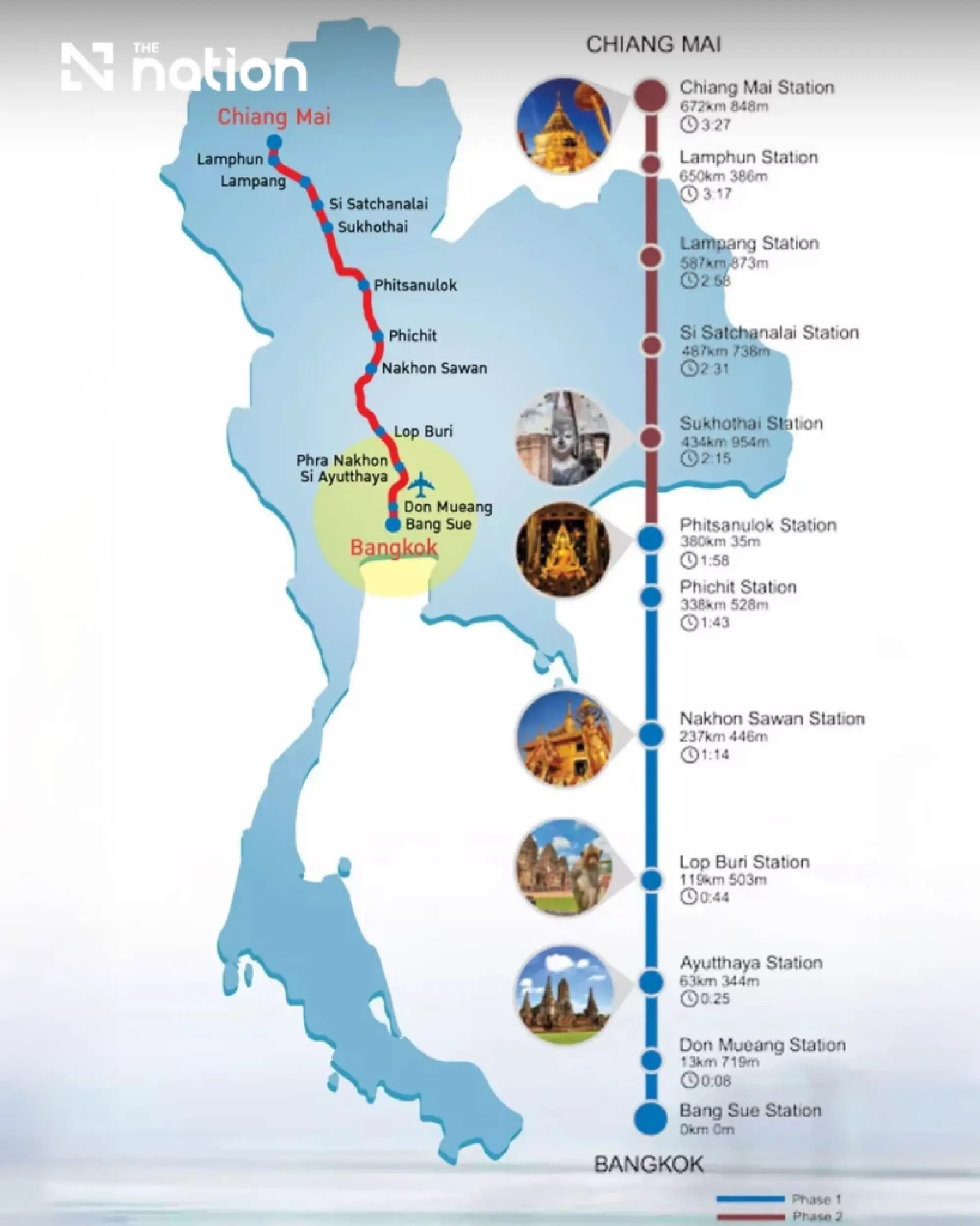 The Ministry of Transport has announced that its 2027 work plan includes preparations to seek Cabinet approval for a new high-speed rail project covering the Bangkok–Phitsanulok section.
The Bangkok–Phitsanulok section forms part of the Bangkok–Chiang Mai high-speed railway project.
Thailand’s Ministry of Transport and Japan’s Ministry of Land, Infrastructure, Transport and Tourism (MLIT) jointly signed a memorandum of understanding (MOU) on rail-system development between Thailand and Japan.
The project has a total length of 668 kilometres and is divided into:
- Phase 1: Bangkok–Phitsanulok, 380 kilometres, with investment of about THB276 billion.
- Phase 2: Phitsanulok–Chiang Mai, 288 kilometres, with investment of about THB232 billion.
For the Bangkok–Phitsanulok section, the environmental impact assessment (EIA) report has been approved by the National Environment Board, while the investment model remains under consideration.
The Ministry of Transport has included the section in its 2027 work plan as a continuing project being prepared for submission to the Cabinet, targeting the start of construction in January 2030 and the launch of services in January 2036.
Source: https://www.nationthailand.com/news/general/40069158
Google Translation:
กระทรวงคมนาคมของไทยเตรียมเสนอโครงการรถไฟฟ้าความเร็วสูงกรุงเทพฯ-พิษณุโลก ระยะทาง 380 กิโลเมตร
ข่าวนี้ได้รับการสนับสนุนโดย FALLPROTEC บริษัทชั้นนำระดับโลกด้านการออกแบบและผลิตระบบป้องกันการตกจากที่สูงและโซลูชันการเข้าถึงที่สูง
กระทรวงคมนาคมของไทยวางแผนที่จะขออนุมัติจากคณะรัฐมนตรีสำหรับโครงการรถไฟฟ้าความเร็วสูงกรุงเทพฯ-พิษณุโลก ซึ่งเป็นส่วนหนึ่งของแผนงานปี 2027
ส่วนนี้ระยะทาง 380 กิโลเมตร เป็นเฟสแรกของโครงการรถไฟฟ้าความเร็วสูงกรุงเทพฯ-เชียงใหม่ ที่ใหญ่กว่า ซึ่งกำลังพัฒนาร่วมกับประเทศญี่ปุ่น
โครงการนี้มีมูลค่าการลงทุนประมาณ 276 พันล้านบาท และการประเมินผลกระทบสิ่งแวดล้อม (EIA) ได้รับการอนุมัติแล้ว
(บทความนี้ได้รับการสนับสนุนโดย FALLPROTEC บริษัทชั้นนำระดับโลกด้านการออกแบบและผลิตระบบป้องกันการตกจากที่สูงและโซลูชันการเข้าถึงที่สูง)
การก่อสร้างมีเป้าหมายที่จะเริ่มในเดือนมกราคม 2563 โดยมีแผนจะเปิดให้บริการในเดือนมกราคม 2569
ประเทศไทยกำลังรอคอยการเปิดให้บริการรถไฟความเร็วสูง ซึ่งเป็นโครงสร้างพื้นฐานใหม่ของประเทศ
โครงการหนึ่งที่กำลังก่อสร้างอยู่ในขณะนี้คือ โครงการรถไฟความเร็วสูงไทย-จีน ส่วนกรุงเทพฯ-นครราชสีมา
คณะรัฐมนตรีอนุมัติโครงการนี้เมื่อวันอังคารที่ 11 กรกฎาคม 2560
การรถไฟแห่งประเทศไทย (ร.ฟ.ท.) รายงานว่าการก่อสร้างเสร็จสมบูรณ์ไปแล้วกว่า 55% โดยมีเป้าหมายที่จะเริ่มให้บริการในปี 2564
ขณะเดียวกัน สัญญาร่วมลงทุนสำหรับโครงการรถไฟความเร็วสูงสายที่สองของประเทศไทย คือ รถไฟความเร็วสูงเชื่อมสามสนามบิน (ดอนเมือง-สุวรรณภูมิ-อู่ตะเภา) ได้ลงนามเมื่อวันพฤหัสบดีที่ 24 ตุลาคม 2562
โครงการนี้ดำเนินมาเป็นปีที่เจ็ดแล้ว แต่การก่อสร้างยังไม่สามารถเริ่มต้นได้ เนื่องจากการเจรจาเพื่อแก้ไขสัญญาร่วมลงทุนยังไม่สามารถหาข้อสรุปได้
นอกจากนี้ ยังมีความเป็นไปได้ที่ข้อเสนอ “ยุติสัญญาร่วมลงทุน” จะถูกนำเสนอต่อคณะกรรมการนโยบายเศรษฐกิจภาคตะวันออก ซึ่งมีนายกรัฐมนตรีอนุทิน ชาญวีรกุล เป็นประธาน เพื่อพิจารณา
ดังนั้น รถไฟความเร็วสูงจึงเป็นอีกหนึ่งโครงการขนาดใหญ่ที่มีความคาดหวังสูง
ความต้องการเงินลงทุนจำนวนมหาศาลทำให้การดำเนินงานเป็นไปได้ยาก ขณะเดียวกันก็ต้องการเทคโนโลยีใหม่ที่ประเทศไทยยังไม่เคยใช้มาก่อน
กระทรวงคมนาคมได้ประกาศว่า แผนงานปี 2027 ของกระทรวงฯ ได้เตรียมการเพื่อขออนุมัติจากคณะรัฐมนตรีสำหรับโครงการรถไฟความเร็วสูงสายใหม่ ครอบคลุมช่วงกรุงเทพฯ-พิษณุโลก
ช่วงกรุงเทพฯ-พิษณุโลกเป็นส่วนหนึ่งของโครงการรถไฟความเร็วสูงกรุงเทพฯ-เชียงใหม่
กระทรวงคมนาคมของไทยและกระทรวงที่ดิน โครงสร้างพื้นฐาน การขนส่ง และการท่องเที่ยวของญี่ปุ่น (MLIT) ได้ลงนามในบันบันทึกความเข้าใจ (MOU) ร่วมกันเกี่ยวกับการพัฒนาระบบรางระหว่างประเทศไทยและญี่ปุ่น
โครงการนี้มีความยาวรวม 668 กิโลเมตร แบ่งออกเป็น:
ระยะที่ 1: กรุงเทพฯ-พิษณุโลก ระยะทาง 380 กิโลเมตร งบประมาณลงทุนประมาณ 276 พันล้านบาท
ระยะที่ 2: พิษณุโลก-เชียงใหม่ ระยะทาง 288 กิโลเมตร งบประมาณลงทุนประมาณ 232 พันล้านบาท
สำหรับช่วงกรุงเทพฯ-พิษณุโลก รายงานการประเมินผลกระทบสิ่งแวดล้อม (EIA) ได้รับการอนุมัติจากสำนักงานคณะกรรมการสิ่งแวดล้อมแห่งชาติแล้ว ขณะที่แบบจำลองการลงทุนยังอยู่ระหว่างการพิจารณา
กระทรวงคมนาคมได้บรรจุช่วงดังกล่าวไว้ในแผนงานปี 2560 ในฐานะโครงการต่อเนื่องที่เตรียมเสนอต่อคณะรัฐมนตรี โดยตั้งเป้าหมายเริ่มก่อสร้างในเดือนมกราคม 2563 และเปิดให้บริการในเดือนมกราคม 2579


