
37.41KM Koh Samui to Mainland Bridge Plan Set for 2029 Construction Start
Thailand’s Expressway Authority (EXAT) has concluded its study into the 74-billion-baht Samui Bridge project, with construction scheduled to begin in 2029 and the route expected to open by late 2033. The 37.41-kilometre expressway will cut travel time between the mainland and Koh Samui from two hours by ferry to just 20 minutes. Motorcycles will be prohibited from using the bridge due to safety concerns.
EXAT Governor Surachet Laophusuk chaired the third public hearing on 13 February 2026 at the College of Interdisciplinary Studies, Koh Samui, under Surat Thani Rajabhat University. The meeting presented findings on engineering feasibility, economics, finance and environmental impact. The project, known as the “Koh Samui Expressway Connection”, carries an estimated investment of 74 billion baht and is projected to generate 400 billion baht in circulating economic value over 30 years.
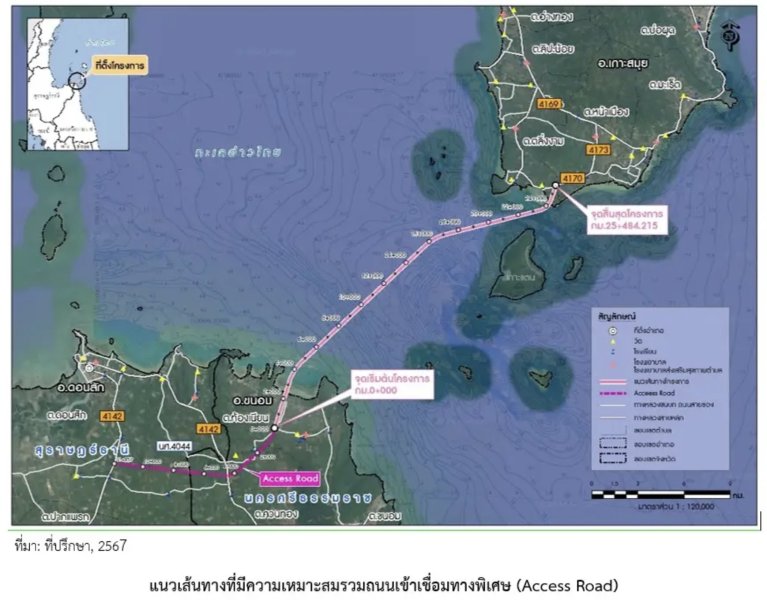
The route will begin at kilometers 14+500 on Highway 4142 in Don Sak district, Surat Thani, pass through Khanom district in Nakhon Si Thammarat, and connect to Highway 4170 on Koh Samui. It will comprise four traffic lanes and feature a 22-kilometre cable-stayed sea bridge with a navigational clearance of at least 50 meters to accommodate large vessels in line with international standards. The expressway will operate 24 hours a day, addressing current limitations on access to and from the island.
 A willingness-to-pay survey found that most motorists would accept a toll of 1,000–1,200 baht per four-wheeled vehicle. EXAT said the bridge will also carry electricity, water supply and telecommunications systems to strengthen infrastructure security on Koh Samui. The alignment passes through a Class 5 watershed area, with authorities stating there will be no impact on water sources and that strict dust and noise mitigation measures will be enforced during construction.
Land expropriation has been identified as a primary concern among residents. EXAT said clear boundary lines will be set and affected landowners will receive compensation based on official appraisals and current market prices, with a formal appeals process in place.
Surachet said the bridge would improve quality of life, particularly for emergency medical transfers after 8pm when ferry services cease. He confirmed motorcycles will not be permitted on the structure, citing strong sea winds at heights exceeding 50 metres, equivalent to 15–20 storeys, which pose accident risks. Alternatives under consideration include motorcycle transport services or continued ferry use.
 Kaoded reported that this year, EXAT will submit the project to its board and the Ministry of Transport. An Environmental Impact Assessment will follow, with Cabinet approval targeted for 2027 before proceeding to a public-private partnership investment process.
Key Takeaways
• Construction of the 74-billion-baht Samui Bridge is planned to begin in 2029, with opening expected in late 2033.
• The 37.41-kilometre route will reduce mainland–Koh Samui travel time to 20 minutes and operate 24 hours daily.
• Motorcycles will be banned from the bridge due to safety risks from strong sea winds at elevations above 50 metres.
Adapted by ASEAN Now Kaoded 14 Feb 2026
Source: https://aseannow.com/topic/1387437-samui-bridge-plan-set-for-2029-construction-start
Google Translation:
The Koh Samui Bridge, connecting the island to the mainland and spanning 37.41 kilometers, is scheduled to begin construction in 2029.
Image from Khaosod.
The Expressway Authority of Thailand (EXAT) has finalized its feasibility study for the 74 billion baht Samui Bridge project. Construction is scheduled to begin in 2029 and the bridge is expected to open by the end of 2033. This 37.41-kilometer expressway will reduce travel time between the mainland and Koh Samui from two hours by ferry to just 20 minutes. Motorcycles will be prohibited on the bridge due to safety concerns.
Mr. Surachet Laopulsuk, Governor of EXAT, chaired the 3rd Public Hearing Meeting on February 13, 2026, at the College of Interdisciplinary Studies, Koh Samui, Suratthani Rajabhat University. This meeting presented the results of the engineering, economic, financial, and environmental impact assessments for the project, also known as the “Koh Samui Expressway,” which has an estimated investment of approximately 74 billion baht and is expected to generate an economic impact of 400 billion baht over 30 years.
The route will start at kilometer 14,500 on Highway 4142 in Don Sak District, Surat Thani Province, pass through Khanom District, Nakhon Si Thammarat Province, and connect to Highway 4170 on Koh Samui. The expressway will have four lanes and a 22-kilometer-long cable-stayed sea bridge with a minimum water depth of 50 meters to accommodate large ships according to international standards. The expressway will be open 24 hours a day to address current limitations on access to and from the island.
A survey of willingness to pay found that most drivers were happy to accept a toll of 1,000-1,200 baht per four-wheeled vehicle. EXAT stated that the bridge will support electricity, water, and telecommunications systems to enhance infrastructure stability on Koh Samui. The bridge passes through a Category 5 watershed area, but authorities stated that it will not affect water sources, and strict measures to reduce dust and noise will be enforced during construction.
Land expropriation is a primary concern for the residents. EXAT stated that land boundaries will be clearly defined, and affected landowners will be compensated based on official valuations and current market prices, with a formal appeals process in place.
Surachet stated that the bridge will improve the quality of life, especially for the transportation of emergency patients after 8 PM when ferry services cease. He confirmed that motorcycles will not be allowed on the bridge due to strong sea winds at a height exceeding 50 meters (equivalent to 15-20 stories), posing a risk of accidents. Alternatives under consideration include motorcycle transport services or continuing the use of ferries.
The Kaoded newspaper reports that this year, EXAT will present the project to the board and the Ministry of Transport. Following this, an environmental impact assessment will be conducted, and approval from the Cabinet is expected in 2027 before proceeding with the public-private partnership (PPP) investment process.
Key points
• The 74 billion baht construction of the Samui Bridge is planned to begin in 2029 and is expected to open for service in late 2033.
• The 37.41-kilometer route will reduce travel time from the mainland to Koh Samui to just 20 minutes and will operate 24 hours a day.
• Motorcycles are prohibited from using the bridge due to safety risks from strong sea winds at altitudes exceeding 50 meters.
Compiled by ASEAN Now Kaoded, February 14, 2026.