 Repeated construction accidents leave Thai government with no choice but to rely on administrative orders to protect the public, rather than civil contract mechanisms, says PM
‘Govt must wield admin orders’
The government is poised to halt state-owned construction projects or cancel contracts with contractors that fail to protect public safety, after another accident on Rama II Road on Saturday added to a string of recent construction fatalities.
Speaking after another road collapse was reported on the inbound lanes of Rama II Road in Muang district of Samut Sakhon province, Prime Minister Anutin Charnvirakul said repeated accidents had left the government with no choice but to rely on administrative orders, rather than civil contract mechanisms, to protect the public.
“When accidents happen repeatedly, pursuing civil remedies under contracts is simply ineffective,” he said. “This is a legal matter. The government must use administrative power to order construction suspensions or contract terminations when public safety cannot be guaranteed.”
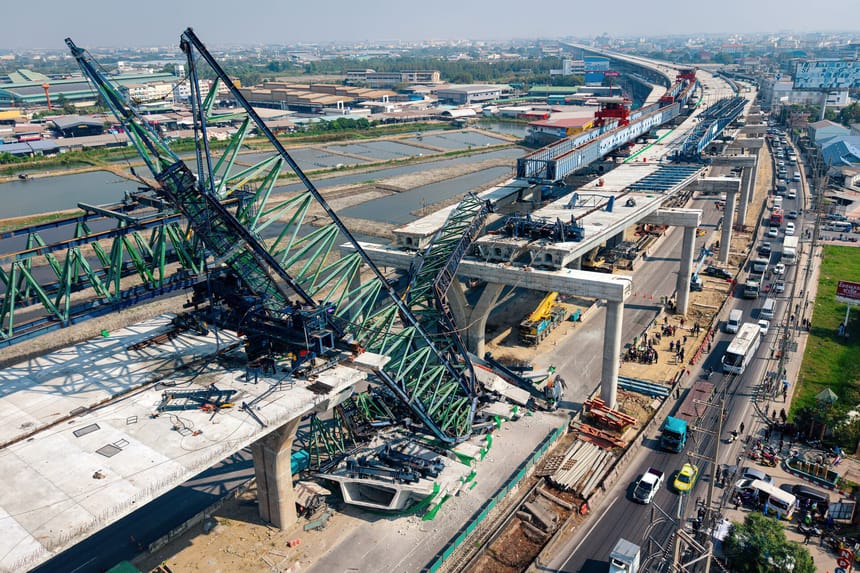
A launching gantry crane collapsed on Thursday at an elevated expressway project on Rama II Road in Samut Sakhon, killing two people and injuring five others. It followed a separate accident in Sikhiu district of Nakhon Ratchasima on Wednesday, when a crane fell onto a passenger train, killing 30 people and injuring 69.
On Thursday, Mr Anutin ordered the Ministry of Transport to terminate two contracts with Italian-Thai Development Plc (ITD), the main contractor involved in the two projects.
He also instructed the ministry to initiate legal proceedings, blacklist the contractor and hold an emergency meeting to review safety measures across all transport-related construction projects.
The decisions were made following consultations with the Council of State and the Attorney General.
Mr Anutin said the accidents had severely shaken public confidence and posed serious threats to lives and property, particularly on Rama II Road, a key artery linking Bangkok to southern provinces.
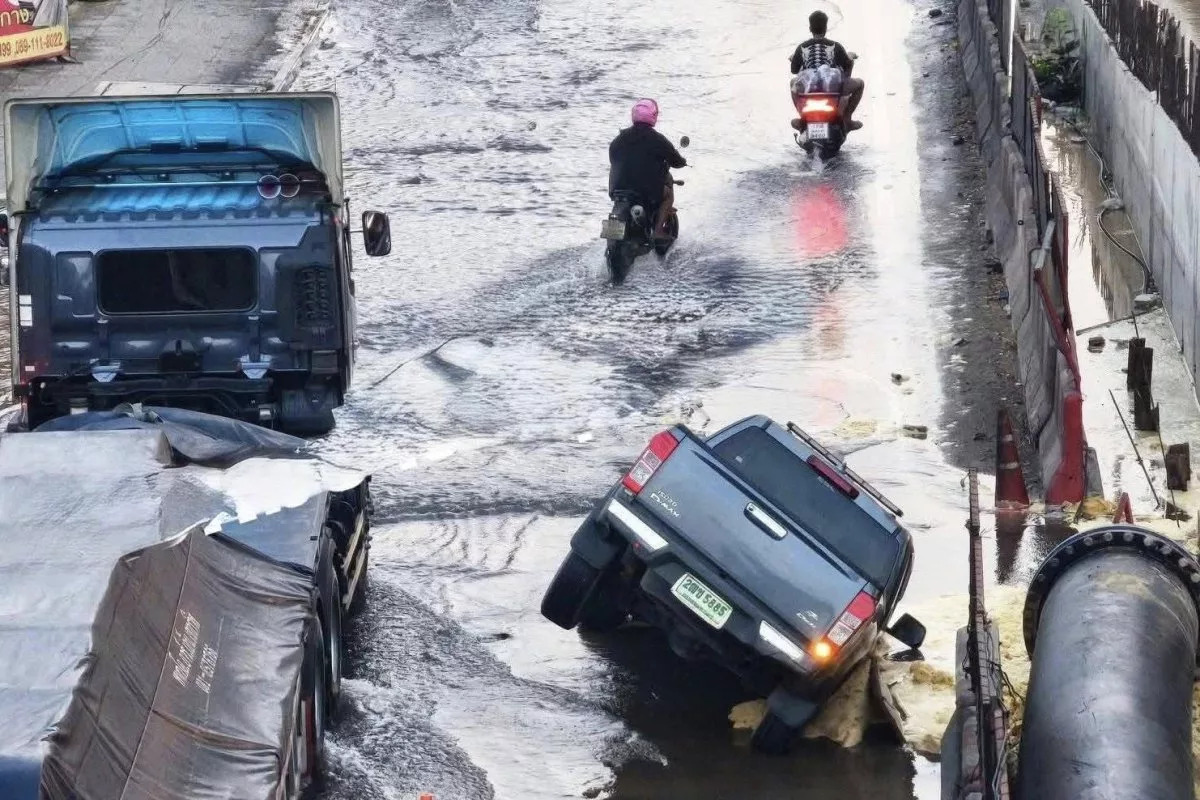
Addressing public concerns about another incident on Rama II Road on Saturday, he said the road subsidence yesterday morning was caused by a burst water pipe and human negligence, not by flaws in structural design or construction methods.
The collapse occurred at 6.30am near kilometre marker 29+350 on the inbound parallel lane in Muang district, Samut Sakhon, causing a pickup truck to fall into a sinkhole. No injuries or fatalities were reported.
The Department of Highways said the damage was caused by the rupture of a 1,000mm water pipe operated by the Samut Sakhon municipality during excavation and pipe-connection work, which led to soil erosion beneath the road surface.
Emergency crews were deployed to manage traffic and secure the area while repairs were carried out.
Mr Anutin acknowledged the concerns, adding the most serious risk lies in structural failures related to lifting operations and construction practices, which are preventable if proper procedures are followed.
“If administrative orders are issued and officials fail to act, civil servants could face legal consequences under Section 157,” he warned, referring to dereliction of duty under the Criminal Code.
Structural engineering experts have also weighed in on the problem.
Prof Amorn Pimanmas, president of the Structural Engineers Association of Thailand, said the road subsidence may have resulted from soil movement into a nearby excavation pit, possibly due to insufficient depth of steel sheet piles used to retain soil in soft ground conditions.
He warned that construction near roads built on soft clay layers requires robust earth-retaining systems to prevent soil displacement, citing a major sinkhole incident on Samsen Road last September linked to underground rail construction.
Meanwhile, investigations into the Nakhon Ratchasima crane collapse are continuing. Provincial health authorities reported 30 confirmed deaths, with 16 injured patients still receiving treatment at hospitals. Nineteen bodies have been released to families for funeral rites.
Police have questioned engineers and machinery personnel from ITD as part of the investigation, with no charges filed so far.
Authorities said forensic experts are examining whether the accident was caused by negligence or equipment failure, noting that cranes do not collapse “without cause”.
Source: https://www.bangkokpost.com/thailand/general/3177654/govt-must-wield-admin-orders
Google Translation:
นายกรัฐมนตรีกล่าวว่า อุบัติเหตุจากการก่อสร้างที่เกิดขึ้นซ้ำแล้วซ้ำเล่า ทำให้รัฐบาลไทยไม่มีทางเลือกอื่นนอกจากต้องพึ่งพาคำสั่งทางปกครองเพื่อปกป้องประชาชน แทนที่จะใช้กลไกสัญญาจ้างเหมา
‘รัฐบาลต้องใช้อำนาจตามคำสั่งทางปกครอง’
อันตรายด้านความปลอดภัย: รถกระบะคันหนึ่งตกลงไปในหลุมยุบหลังจากส่วนหนึ่งของถนนพระราม 2 เลนขาเข้าทรุดตัวลงใกล้กิโลเมตรที่ 29+300 ในจังหวัดสมุทรสาคร เมื่อเช้าวันเสาร์ที่ผ่านมา หลุมยุบดังกล่าวมีความลึกประมาณ 1 เมตร และยังทำให้ท่อน้ำแตก ส่งผลให้น้ำประปาพุ่งออกมาและท่วมพื้นที่โดยรอบ
รัฐบาลเตรียมที่จะระงับโครงการก่อสร้างของรัฐ หรือยกเลิกสัญญาจ้างกับผู้รับเหมาที่ล้มเหลวในการปกป้องความปลอดภัยของประชาชน หลังจากเกิดอุบัติเหตุอีกครั้งบนถนนพระราม 2 เมื่อวันเสาร์ ซึ่งเป็นการเพิ่มจำนวนผู้เสียชีวิตจากอุบัติเหตุก่อสร้างในช่วงที่ผ่านมา
นายกรัฐมนตรี อนุทิน ชาญวีรกุล กล่าวหลังจากมีรายงานเหตุถนนทรุดตัวอีกครั้งบนเลนขาเข้าของถนนพระราม 2 ในอำเภอเมือง จังหวัดสมุทรสาคร ว่าอุบัติเหตุที่เกิดขึ้นซ้ำแล้วซ้ำเล่าทำให้รัฐบาลไม่มีทางเลือกอื่นนอกจากต้องพึ่งคำสั่งทางปกครองมากกว่ากลไกสัญญาทางแพ่ง เพื่อปกป้องประชาชน
“เมื่อเกิดอุบัติเหตุซ้ำแล้วซ้ำเล่า การใช้มาตรการทางแพ่งภายใต้สัญญาจึงไม่มีประสิทธิภาพ” เขากล่าว “นี่เป็นเรื่องทางกฎหมาย รัฐบาลต้องใช้อำนาจปกครองสั่งระงับการก่อสร้างหรือยกเลิกสัญญาเมื่อไม่สามารถรับประกันความปลอดภัยของประชาชนได้”
เครนยกโครงสร้างถล่มเมื่อวันพฤหัสบดีที่ผ่านมาในโครงการทางด่วนยกระดับบนถนนพระราม 2 จังหวัดสมุทรสาคร ทำให้มีผู้เสียชีวิต 2 รายและบาดเจ็บอีก 5 ราย เหตุการณ์นี้เกิดขึ้นหลังจากอุบัติเหตุอีกครั้งในอำเภอสิขิ่ว จังหวัดนครราชสีมา เมื่อวันพุธที่ผ่านมา ซึ่งเครนล้มทับรถไฟโดยสาร ทำให้มีผู้เสียชีวิต 30 คน และบาดเจ็บ 69 คน
เมื่อวันพฤหัสบดี นายอนุทินได้สั่งการให้กระทรวงคมนาคมยกเลิกสัญญา 2 ฉบับกับบริษัท อิตาเลียน-ไทย ดีเวลลอปเมนท์ จำกัด (มหาชน) (ITD) ซึ่งเป็นผู้รับเหมาหลักในโครงการทั้งสอง
นอกจากนี้ เขายังสั่งการให้กระทรวงดำเนินการทางกฎหมาย ขึ้นบัญชีดำผู้รับเหมา และจัดการประชุมฉุกเฉินเพื่อทบทวนมาตรการความปลอดภัยในโครงการก่อสร้างที่เกี่ยวข้องกับการขนส่งทั้งหมด
การตัดสินใจดังกล่าวเกิดขึ้นหลังจากปรึกษาหารือกับสภาที่ปรึกษาแห่งรัฐและอัยการสูงสุด
นายอนุทินกล่าวว่า อุบัติเหตุเหล่านี้ได้สั่นคลอนความเชื่อมั่นของประชาชนอย่างรุนแรง และเป็นภัยคุกคามร้ายแรงต่อชีวิตและทรัพย์สิน โดยเฉพาะอย่างยิ่งบนถนนพระราม 2 ซึ่งเป็นเส้นทางหลักที่เชื่อมกรุงเทพฯ กับจังหวัดทางภาคใต้
ส่วนเรื่องเหตุการณ์อีกเหตุการณ์หนึ่งบนถนนพระราม 2 เมื่อวันเสาร์ เขาชี้แจงว่า การทรุดตัวของถนนเมื่อเช้าวันเสาร์เกิดจากท่อน้ำแตกและความประมาทของมนุษย์ ไม่ใช่จากความบกพร่องในการออกแบบโครงสร้างหรือวิธีการก่อสร้าง
เหตุการณ์ถนนทรุดตัวเกิดขึ้นเมื่อเวลา 6.30 น. บริเวณหลักกิโลเมตรที่ 29+350 บนเลนขาเข้า ในอำเภอเมือง จังหวัดสมุทรสาคร ทำให้รถกระบะตกลงไปในหลุมยุบ ไม่มีรายงานผู้บาดเจ็บหรือเสียชีวิต
กรมทางหลวงระบุว่า ความเสียหายเกิดจากการแตกของท่อน้ำขนาด 1,000 มิลลิเมตร ที่ดำเนินการโดยเทศบาลนครสมุทรสาคร ระหว่างการขุดและวางท่อ ทำให้เกิดการกัดเซาะดินใต้ผิวถนน
เจ้าหน้าที่กู้ภัยถูกส่งไปจัดการจราจรและรักษาความปลอดภัยในพื้นที่ขณะดำเนินการซ่อมแซม
นายอนุทินรับทราบถึงข้อกังวลดังกล่าว พร้อมเสริมว่า ความเสี่ยงที่ร้ายแรงที่สุดอยู่ที่ความเสียหายทางโครงสร้างที่เกี่ยวข้องกับการยกและการก่อสร้าง ซึ่งสามารถป้องกันได้หากปฏิบัติตามขั้นตอนที่ถูกต้อง
“หากมีการออกคำสั่งทางปกครองแล้วเจ้าหน้าที่ไม่ดำเนินการ ข้าราชการอาจต้องรับโทษตามกฎหมายมาตรา 157” เขากล่าวเตือน โดยอ้างถึงการละเลยหน้าที่ตามประมวลกฎหมายอาญา
ผู้เชี่ยวชาญด้านวิศวกรรมโครงสร้างได้แสดงความคิดเห็นเกี่ยวกับปัญหานี้เช่นกัน
ศาสตราจารย์อมร พิมานมาส ประธานสมาคมวิศวกรโครงสร้างแห่งประเทศไทย กล่าวว่า การทรุดตัวของถนนอาจเกิดจากการเคลื่อนตัวของดินเข้าไปในหลุมขุดใกล้เคียง ซึ่งอาจเกิดจากความลึกของแผ่นเหล็กยึดดินไม่เพียงพอในสภาพดินอ่อน
เขาเตือนว่า การก่อสร้างใกล้ถนนที่สร้างบนชั้นดินเหนียวอ่อน จำเป็นต้องมีระบบยึดดินที่แข็งแรงเพื่อป้องกันการเคลื่อนตัวของดิน โดยอ้างถึงเหตุการณ์หลุมยุบครั้งใหญ่บนถนนสามเสนเมื่อเดือนกันยายนปีที่แล้ว ซึ่งเชื่อมโยงกับการก่อสร้างรถไฟฟ้าใต้ดิน
ขณะเดียวกัน การสอบสวนเหตุการณ์เครนถล่มที่จังหวัดนครราชสีมายังคงดำเนินต่อไป หน่วยงานสาธารณสุขจังหวัดรายงานผู้เสียชีวิตที่ได้รับการยืนยันแล้ว 30 ราย และผู้บาดเจ็บ 16 รายยังคงรักษาตัวอยู่ในโรงพยาบาล ศพ 19 ศพได้ถูกส่งมอบให้ครอบครัวเพื่อประกอบพิธีศพแล้ว
ตำรวจได้สอบปากคำวิศวกรและเจ้าหน้าที่เครื่องจักรจากกรมการขนส่งทางบก (ITD) ในฐานะส่วนหนึ่งของการสอบสวน แต่ยังไม่มีการตั้งข้อหาใดๆ ในขณะนี้
เจ้าหน้าที่กล่าวว่าผู้เชี่ยวชาญด้านนิติวิทยาศาสตร์กำลังตรวจสอบว่าอุบัติเหตุเกิดจากความประมาทหรือความบกพร่องของอุปกรณ์หรือไม่ โดยระบุว่าเครนจะไม่พังถล่ม “โดยไม่มีสาเหตุ”