The greening of power – how Thailand’s Government Complex has transformed into a climate-resilient, human-centric public space
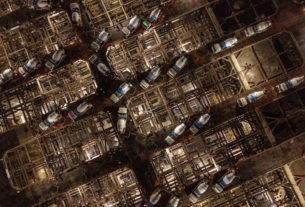
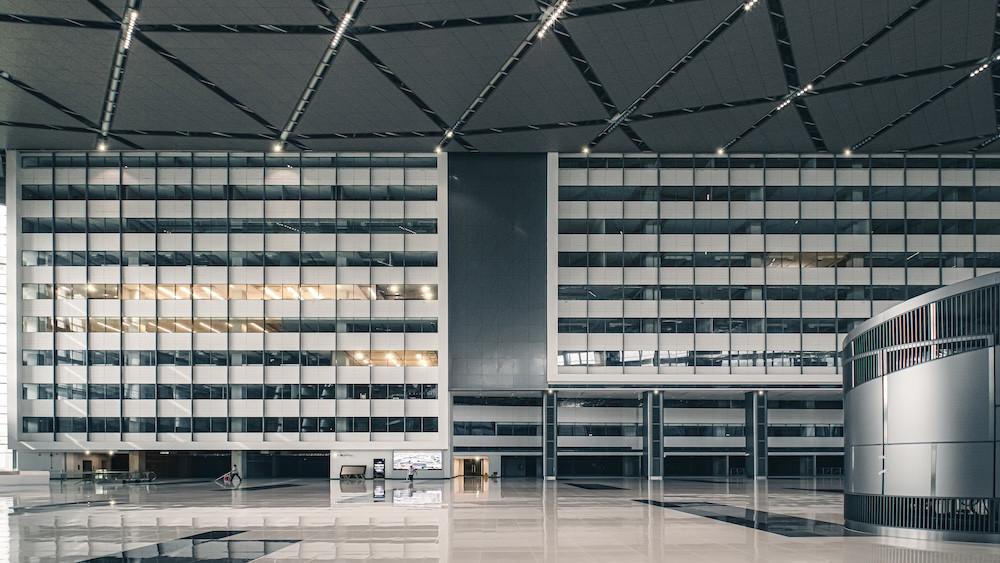
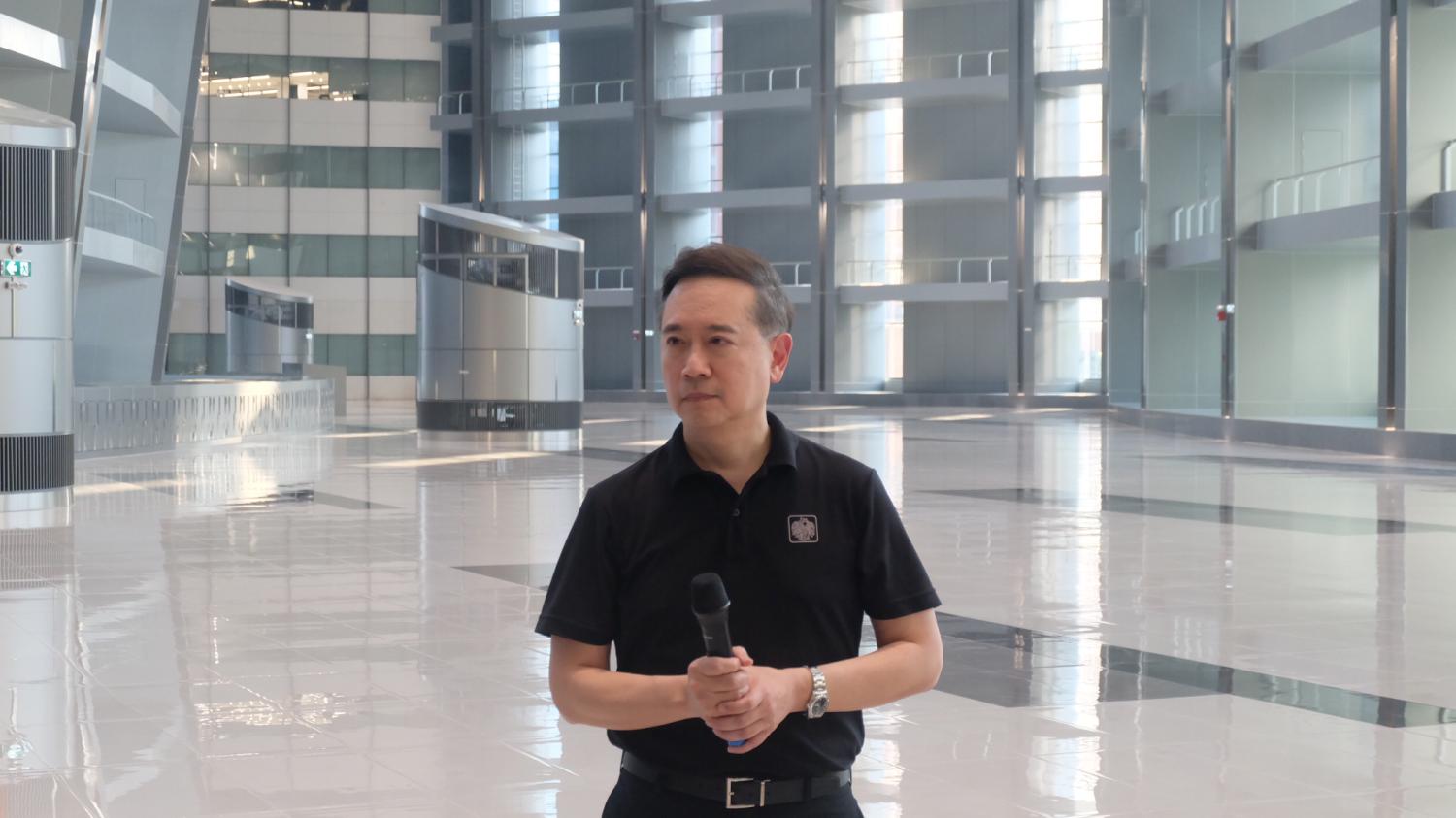
‘It is full of concrete. Dry and barren.” That was his first impression of Government Complex on Chaeng Watthana Road when Nalikatibhag Sangsnit took the helm at Dhanarak Asset Development (DAD).
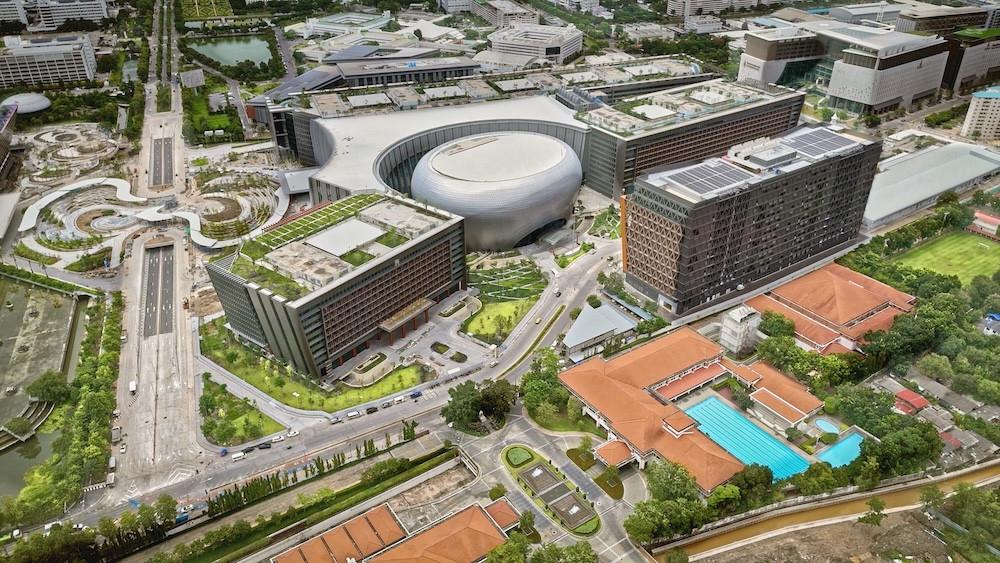
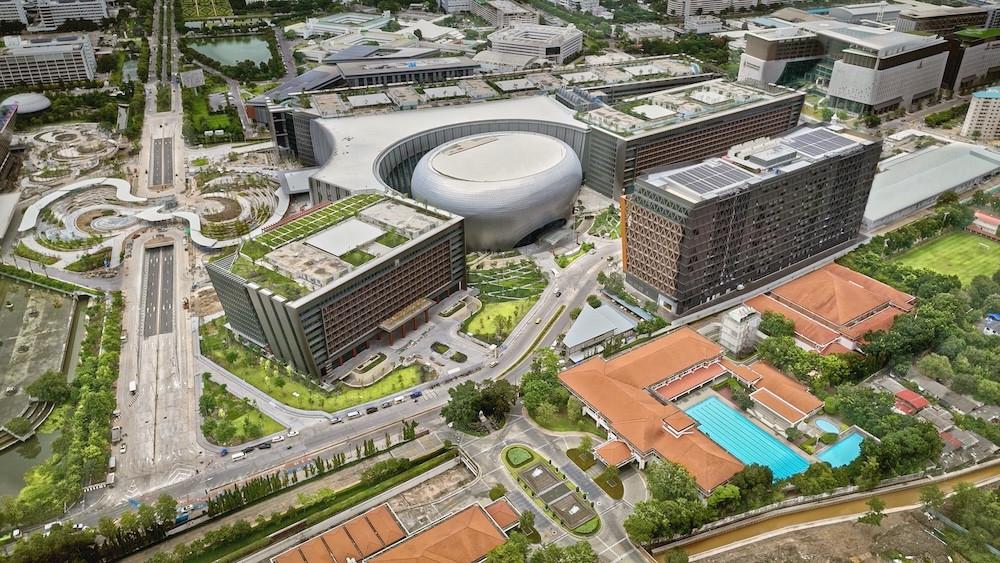
Supervised by the Treasury Department, DAD, a state enterprise, is the administrator of the country’s largest bureaucratic hub as well as other public assets. Covering 378 rai, Government Complex in Bangkok’s Lak Si district houses more than 50 agencies, serving over 40,000 staff and visitors daily.
For years, the heart of administrative power has been the epitome of car-centric design. The area is notorious for traffic jams and a shortage of parking space. In light of climate change, it also experiences flooding. According to the World Bank, 40% of Bangkok could sink due to extreme rainfall and sea-level rise by 2030.
“When I leave, it must be greener,” Nalikatibhag told Life in an interview earlier this month.
During Covid-19, the managing director worked with Kotchakorn Voraakhom, the founder of Landprocess, to transform this outdated legacy into a future-proof model. After more than six years, redevelopment is near completion. Despite being government property, the facilities are open for public use.
“We have restored people’s connection to nature. It isn’t just about putting up new infrastructure. We are envisioning a low-carbon city,” he said.
Blueprint for the future
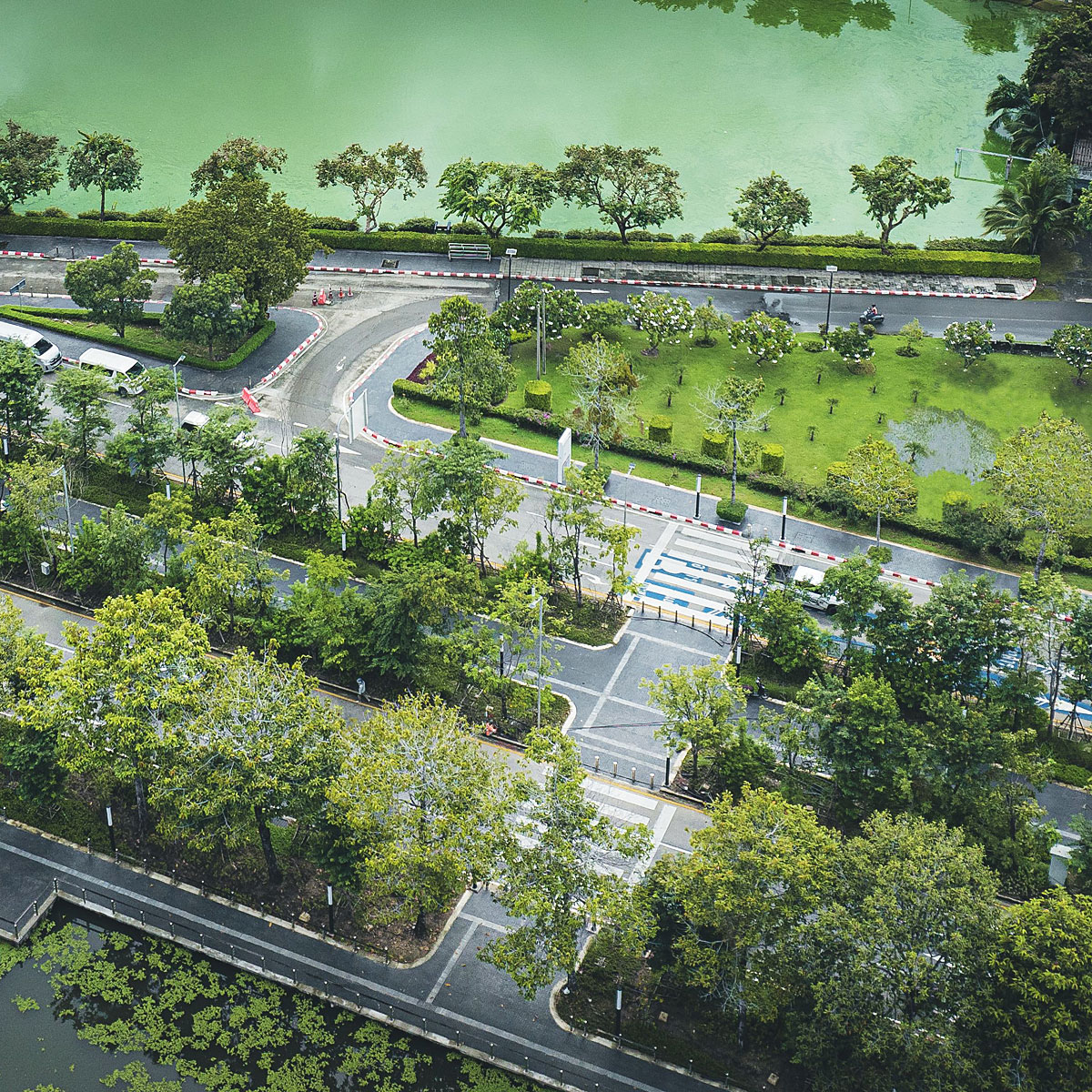
Multifunctional design features came together to achieve climate resilience and facilities were added to promote human-centric mobility. With the advent of the Pink Line sky train, a covered skywalk leads directly to a sky park. Meanwhile, powered by solar energy, EV shuttle buses operate around campus. Also, a hybrid park reclaims space for pedestrians while providing an underpass for drivers.
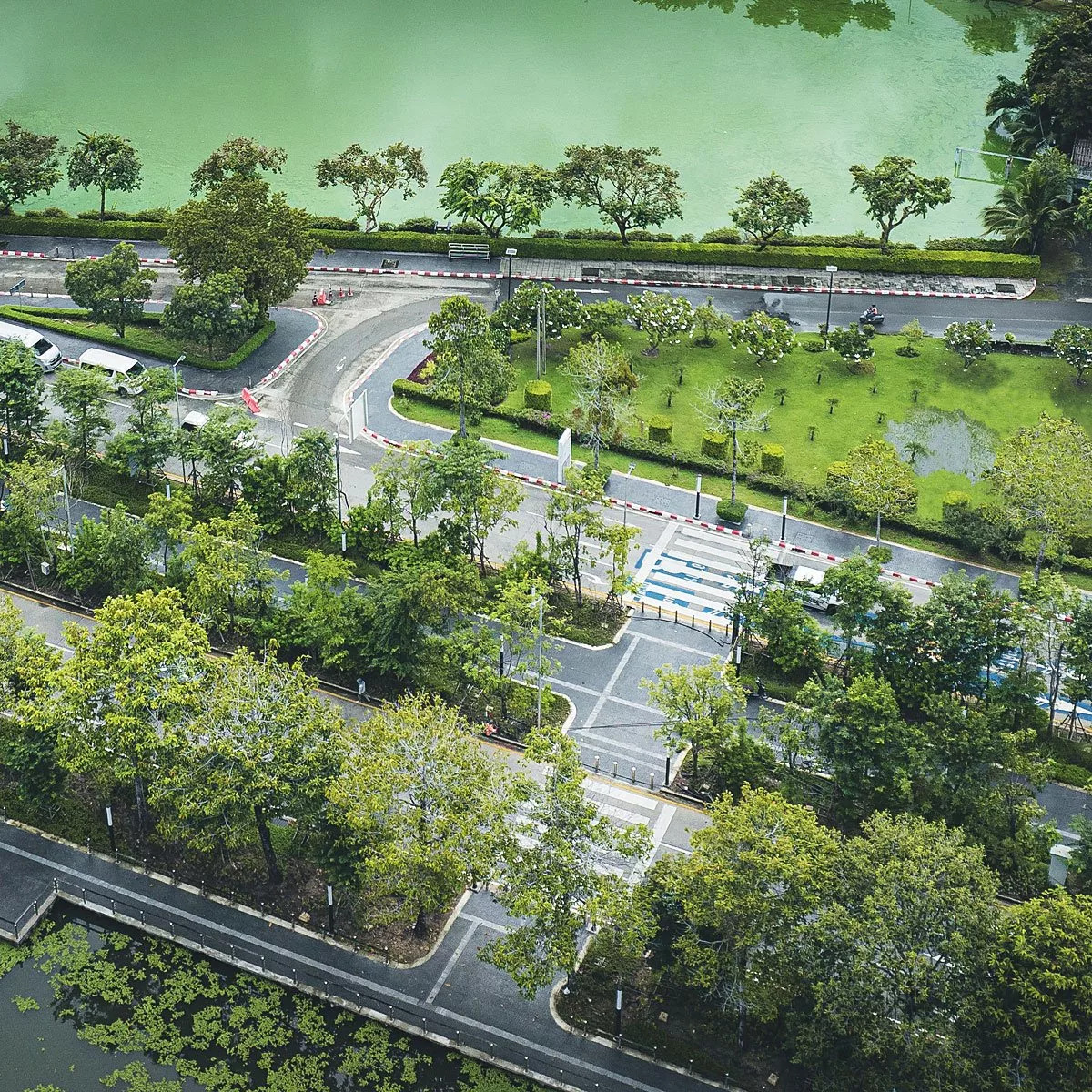
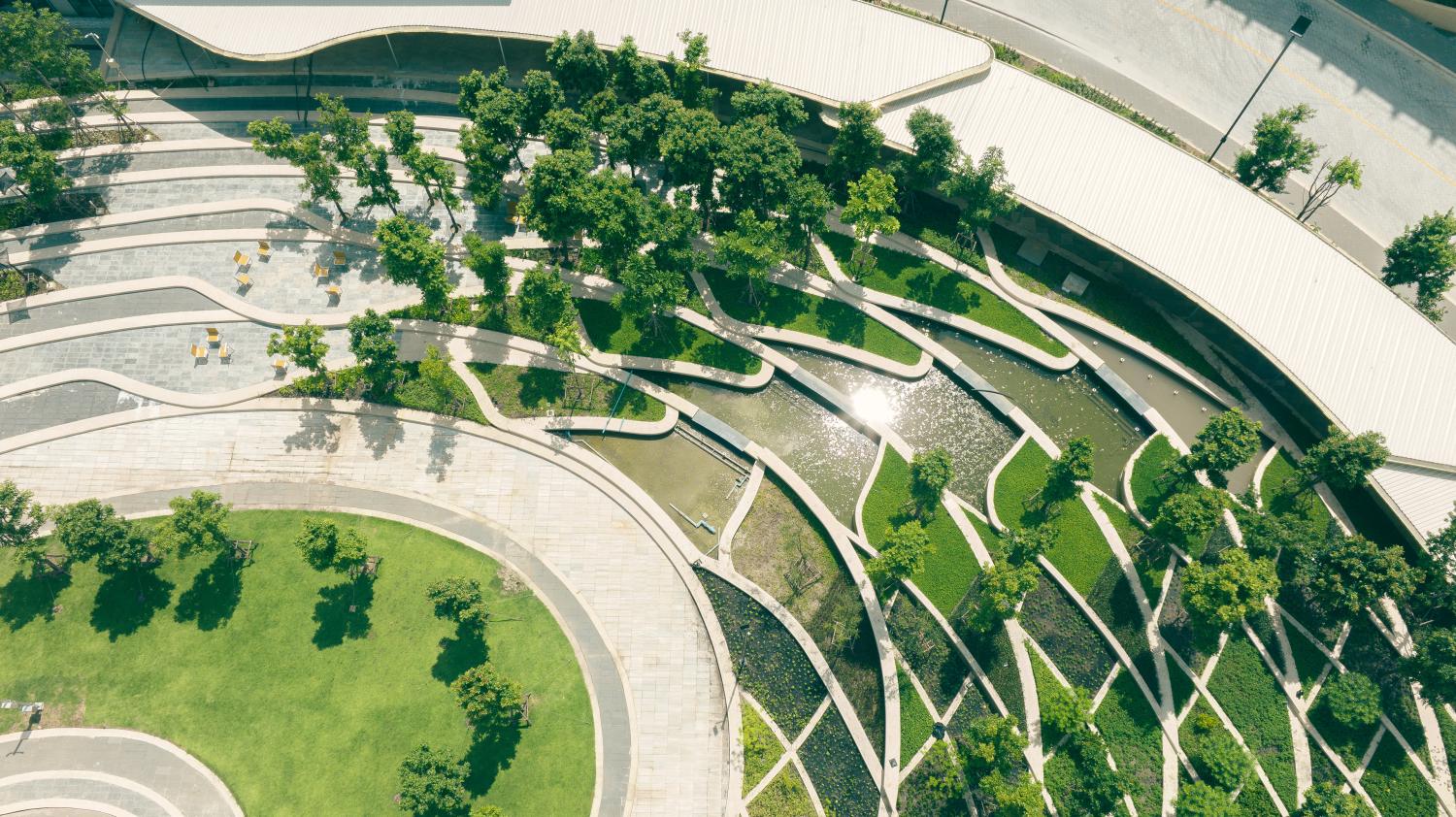
Structures were also retrofitted to increase greenery and mitigate flood risk. Once a back-office garage, a sky park was developed to serve as a lush community area. A sponge park — or artificially engineered wetland — with a solar-celled rooftop garden uses cascading rain chains and vertical planters to achieve zero-runoff discharge and features local vegetation to cool temperatures.
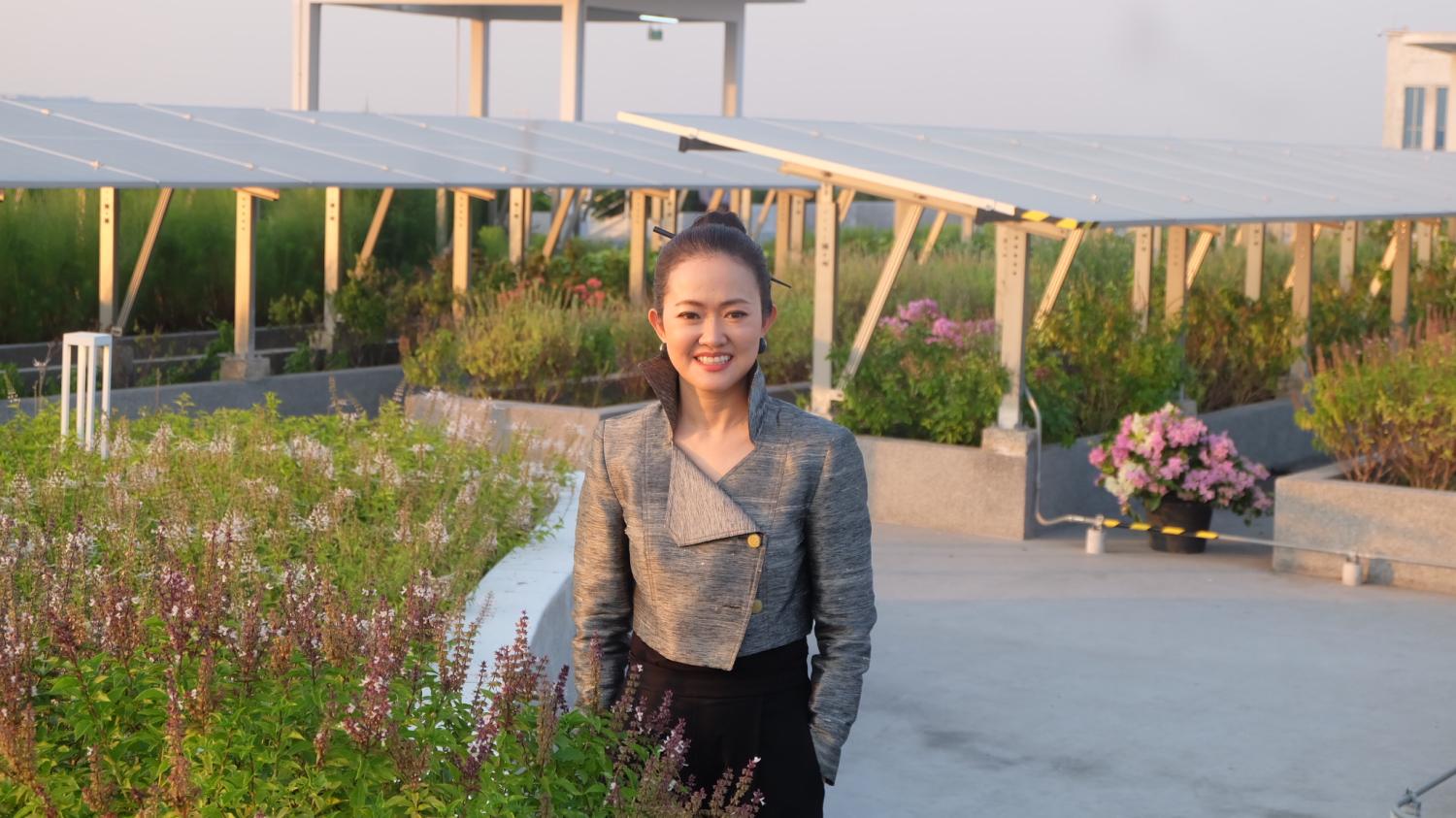
Over 5,500 trees were also planted along concrete corridors to promote biodiversity while creating bioswales, that slow and redirect stormwater runoff, and reducing urban heat. Lastly, an office was designed to save and produce energy. It is equipped with solar shields, panels, cooling systems and a rooftop garden to reduce energy consumption and greenhouse gas emissions, which aligns with the country’s long-term goal of carbon neutrality by 2050.
“Change can start in the government sector,” said Nalikatibhag. “This is a blueprint for the future of cities. Urban harmony with nature isn’t just a dream or policy, but a guideline for urban development.”
Philosophy behind design
“Government buildings are often inaccessible and lifeless. Nature is decorative,” said Kotchakorn.
A human-oriented mobility approach reflects equity, she noted. With the Pink Line, the covered skywalk and solar-powered shuttle buses allow visitors, regardless of their background, to have equal access to the government centre. Use of public transport has grown from 34% to 40% over the past six months.
“We didn’t start from a blank slate. It was challenging to overcome a negative situation [inaccessibility]. Now, you have the choice of transport. No need to drive a car,” she said.
While addressing the pain point of traffic congestion, she injected nature-based solutions into design. Pointing at sponge park which harvests and recycles rainwater, she noted that it comes down to a new paradigm — regeneration — that better meets challenges than conventional sustainability.
“If every building can manage runoff, we will be able to address flooding. Regeneration should be common practice. Nature is the best source,” she said.
When it comes to expanding green spaces, no stone was left unturned in finding underutilised areas. For example, a garage, a road surface or roof. Redevelopment has turned decorative green space of 38 rai into functional green space of 138 rai. However, there is more to the number than meets the eye.
“The 138 rai is green infrastructure. It plays an active role like collecting water and promoting biodiversity which benefits the ecosystem,” she said.
Making a new gesture
Curves are central to her design, integrated into the skywalk and sponge park. “Yes,” Kotchakorn smiled. “I am inspired by the flow of water.”
She said government buildings are often designed in a masculine way, characterised by formality and symmetry. By adding a feminine touch to the bureaucratic complex, she has broken the mould to change public perception.
“It is a new gesture,” she said. “We often ask what the government’s low-carbon, net-zero policies really translate into. Here is the answer. I am happy to be part of the change. It happens when power meets design.”
Redevelopment, however, encountered challenges along the way. Due to the nature of the project, DAD had to deal with regulations and break silos across government agencies to push ahead with construction. Evidence was also needed to prove that adding greenery was an efficient way to reduce temperature.
When asked about the duration of this project, Kotchakorn said it took 6.5 years to expand green space (138 rai) and five years to do the same thing at Chulalongkorn University Centenary Park (30 rai). Given such a different scale, she said it was quite fast.
In need of more action
Landprocess’ mission is to “shift cities to a carbon-neutral future and confront the future climate uncertainty”. Opened in 2017, CU Centenary Park, touted as Bangkok’s first critical green infrastructure, serves as a model of flood prevention in the sinking city. Rain flows from the green roof to artificial wetlands and a retention pond where water sustains all living things in its ecosystem.
Other projects include the Thammasat University Urban Rooftop Farm, completed in late 2019 and regarded as Asia’s largest, Chong Nonsi Canal Park, opened in late 2021, and many more.
Kotchakorn said that while scaling up and maintenance is challenging, showing initiative is also crucial. “Tons of solutions, but no action,” she said. While world leaders pledge to achieve net-zero goals, she thinks “it rarely translates into anything concrete”.
“I don’t know if we lead on a global stage in terms of sustainability efforts, but we are definitely one of the most environmentally vulnerable in the world,” Kotchakorn said.
For her, climate change manifests differently in each country and it is time to find our own way. “And here lies some hope,” she said.
Source: https://www.bangkokpost.com/life/social-and-lifestyle/3153723/the-greening-of-power